
Grape harvest, vineyards and wine – discovering paradise in Biscoitos

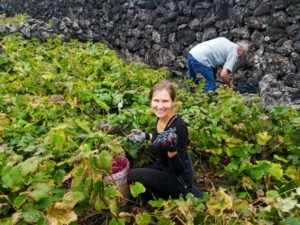
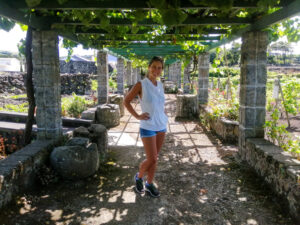
Grape harvest, vineyards and wine – discovering paradise in Biscoitos A few days ago I went to the grape harvest for the first time in my life. Thus, I fulfilled my dream from several years ago. What happened several years ago? Well, a dozen or so years ago I was walking among the vineyards in Germany. Delighted. Vast hills filled with rows of sun-ripened grapes. The gentle rustle of leaves. Something beautiful! I thought then: I want that too! I want to take part in the grape harvest too. I want to contribute to the wine! Years passed and I admired more vineyards as a guest I admired the vineyards in Biscoitos, admired the vineyards in Pico, listened to the stories about wine making in Porto, I even read articles about wine in Poland! And this year I started walking regularly among the vineyards. Not that I was doing it on purpose. Just my way to the beach ran through the vineyards. I saw them every day. And after a while – I started talking about them. With different people. One of these people was – as it turned out – the owner of one of the vineyards in Biscoitos. After a few talks, he invited me to participate in the grape harvest. I almost jumped with joy! I was asking at least once a week when was that day. And finally a few days ago the grape harvest took place. With my participation. I was overjoyed! I got up at dawn, dressed in black from head to toe (so that there would stay no stains from dark grapes) and set off on the adventure. I was given a bucket, a pair of gloves and a secateurs on the spot. And a brief instruction on which grapes should be cut and which ones shouldn’t be used. And I was ready to go! In the Azores, wine grows differently than in the vineyard I saw in Germany. The vines are not suspended on vertical structures here, but grow horizontally on black volcanic rocks. I wrote about why this is so in the article „Biscoitos wine„. Grapes hide under the leaves Before starting work, I looked around the vineyard. And I remembered my friend’s story about his first grape harvest. He said, “I looked down at the vine and I thought there weren’t any grapes there. But when I picked up the branch, I got surprised.” I smiled at that memory and squatted beside my first vine. I picked up a branch and saw a paradise. Beautiful purple bunches waited safely under the leaves for someone to take an interest in them. I got down to work. Buckets got filled one after the other I had to be very careful where I put my feet on loose volcanic stones. So I wouldn’t break my legs. And my exposed ankles were quickly all scratched with sharp vines. But I was working. Me and a dozen men with an average age of about 60-65 years. Buckets got filled one after the other. We poured their contents into large containers that a few of the stronger men carried onto car trailers. And so for several hours. Until all the grapes were harvested, all the containers were full, and it was possible to take the fruit to the adega, i.e. the wine house. The next day, the grapes were separated from the stalks and the fruit was squeezed out. I just watched this part of the process. The men used a machine specially built for this purpose to remove the stalks from the grapes. The juice was pressed in a large wooden press. The grapes were loaded into something like a barrel, which was pressed from above with pieces of wood. Imagine a hand jack but going down, not up. It was something like that. The juice flowed into a large basin, and from there it was pumped into huge stainless steel containers with a special device. Containers of 500 or 1000 liters. Of course, it wasn’t done on its own. It took a lot of work and sweat and a lot of grape juice stains on the shirts of the men working on it. Next year this wine will appear on the tables during Festas do Espírito Santo I have always wondered where the wine served during the celebration of the Holy Spirit holidays comes from. Now I know! And next year I will look for „our” wine! Some of the grape juice will be transformed into a local alcohol called angelica. I recently got a bottle of this, heaven in mouth! And what will happen to the stalks? The stalks will return to the ground as a fertilizer. Nothing can be wasted in this process! You never know There was one person about my age who was also involved in the grape harvest. Both my and his attention was drawn to the fact that all the other people are around 60-65 years old, maybe more. They are men with vast knowledge and vast experience. I hope they will live a long time, but I wondered what would happen to the vines in Terceira when they are gone. They say directly that local vines hardly make money. They deal with grapevines because that’s their whole life. All their knowledge is in their heads. They don’t have smart books, they just listen to plants. They know when to fertilize them, when to trim them, when to harvest. They know which varieties are resistant to the vines scourge, phylloxera, and which ones need to be grafted. They don’t hire people for the harvest, they help each other. They love the earth, they love vines. And despite their strength and enormous energy, they have more and more, not less, years. They asked me half-jokingly if I’m planning to buy a vineyard. I replied, „You never know.” The Azores Read more about Azores 2018-01-25 The Azores 10 places worth visiting in Terceira 10 places worth visiting in Terceira When I
10 places worth visiting in Terceira

10 places worth visiting in Terceira When I decided to describe 10 places worth visiting in Terceira, I thought: but there are many more places worth visiting here! Terceira is a small island (around 400 sq. m) but full of beauty. But I realize that not everybody has a privilege to spend here as much time as I do. That’s why I chose “must see” places. And made sure that you won’t spend half a day looking for them. So, shall we start? 1. Volcano Algar do Carvão As it is my favourite place on the whole Island, of course it has to be on the first place. There are plenty of volcanoes on the Azores, but this one is unique. Why? Because you can see it from the inside! From the inside of the volcanic cone! What is it about? In most of the volcanoes, after the eruption the cone collapses and creates a caldera. Here it was different. Here during the second eruption which created the volcano, lava was flowing under such small pressure that as some point it started getting back. When it was getting back, it was strengthening the cone. That’s why the volcano, apart from undergoing natural changes, survived in the condition that we can admire until today. In Europe there are only two known empty volcanoes (in the whole world – three), which you can visit from the inside. This is Algar do Carvão in Terceira and Thrihnukagigur in Iceland. As you can see, the Atlantic Ocean favours untypical geological events. In Algar do Carvão you can see such unique work of nature as stalactites and stalagmites from amorphous silica. They are milk-white, beautiful and they may reach up to around 1 m of length and 40-50 cm in diameter. Visiting Algar do Carvão is now possible for the whole year. During winter – in chosen week days, since spring until autumn – every day. It’s worth getting dressed warmly because it’s cold inside and there is dropping water there (which creates a lagoon at the bottom of the cave). A standard visit takes around half an hour, although in my opinion it’s worth planning at least an hour for this experience. There’s a guide inside the cave who will explain you everything and answer your questions. There also leaflets in different languages, including Polish. If you want to get to know more about the volcano, check the website of the Association Os Montanheiros, which takes care of the volcano. Website of the Association Os Montaheiros: HEREMore information about the volcano Algar do Carvão: HEREOpening hours and ticket prices: HERE 2. Lava tube Gruta do Natal As we’re already under ground, let’s visit also a lava tube Gruta do Natal. Some guides, wanting to help tourists, use the English name Christmas Cave. Where is this name coming from? Well, it started with a mess, which was organized by the Association Os Montaheiros (it also take care of this cave) during Christmas time in 1969. Since then, every now and again important historical and social events take place in this cave. Gruta do Natal is a cave shaped by flowing lava. Inside of it, you will see such lava curiosities as stafilites (“stalagmites” made of dropping lava), lava flows and lateral “counters”. There are also different kinds of lava there, including lava aa. Once I heard a story that it’s called like that because when you walk on it, you say: “Aa!” Its rough surface indeed provokes such sounds, I wouldn’t like to stand on it barefoot. Important logistic and payment information: you can buy one ticket to both the volcano Algar do Carvão and to Gruta do Natal, this way you will pay less. You don’t have to use the ticket on the same day, but before planning a visit it’s worth checking opening days and hours, to not go away empty-handed. More information about the lava tube Gruta do Natal: HEREOpening hours and ticket prices: HERE 3. Furnas do Enxofre Between the empty volcano and the lava tube there’s a place called Furnas do Enxofre. When you will be going from Algar do Carvão to Gruta do Natal, turn right, the road sign will lead you. “Furna” means a grot or a cave, “enxofre” – Sulphur, so theoretically Furnas do Enxofre are a grot of Sulphur, but in reality it’s an area of secondary volcanic activity in Terceira. You can see there and smell gas sulphur compounds plumming from the ground. Who remembers from chemistry classes what’s the smell of hydrogen sulphide? As befits a volcanic area, Furnas do Enxofre is a beautiful site with juicy greenery. (Volcanic soils are very fertile, and the Azorean climate is favourable for all kinds of vegetation). Apart from the fumaroles – places where gas is pluming from the Earth. There, because of huge concentration of iron and Sulphur, the soil is bare and has white-yellow-brownish colour. It can arouse small anxiety, but only small. Because if the gas can plume, it’s a bit calmer underground. The water in a pod is boiling, but a bit leaky lid let the steam “escape”, so the content of the pod shouldn’t suddenly boil over. 4. Santa Bárbara – the highest point in Terceira Let’s move up from the lowlands and undergrounds – maybe to the clouds? To the peak Serra de Santa Bárbara – the highest point of Terciera. It has 1021 m above sea level and you can see from there a big part of Terceira, the omnipresent ocean and incredible sunset. Of course if you get lucky and if St. Barbara is not hidden in clouds. The truth is that’s it’s the middle of the Atlantic ocean and the clouds, which flow fast, are being stopped by hills. So I suggest observing the weather and going to Serra de Santa Bárbara (it’s a very characteristic peak, with lots of antennas and transmitters) the moment you see its peak. It’s worth it! I have almost forgotten to