
Grape harvest, vineyards and wine – discovering paradise in Biscoitos

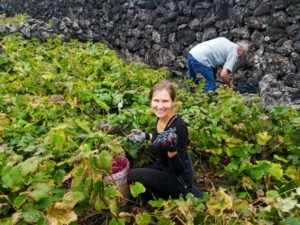
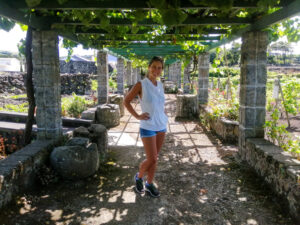
Grape harvest, vineyards and wine – discovering paradise in Biscoitos A few days ago I went to the grape harvest for the first time in my life. Thus, I fulfilled my dream from several years ago. What happened several years ago? Well, a dozen or so years ago I was walking among the vineyards in Germany. Delighted. Vast hills filled with rows of sun-ripened grapes. The gentle rustle of leaves. Something beautiful! I thought then: I want that too! I want to take part in the grape harvest too. I want to contribute to the wine! Years passed and I admired more vineyards as a guest I admired the vineyards in Biscoitos, admired the vineyards in Pico, listened to the stories about wine making in Porto, I even read articles about wine in Poland! And this year I started walking regularly among the vineyards. Not that I was doing it on purpose. Just my way to the beach ran through the vineyards. I saw them every day. And after a while – I started talking about them. With different people. One of these people was – as it turned out – the owner of one of the vineyards in Biscoitos. After a few talks, he invited me to participate in the grape harvest. I almost jumped with joy! I was asking at least once a week when was that day. And finally a few days ago the grape harvest took place. With my participation. I was overjoyed! I got up at dawn, dressed in black from head to toe (so that there would stay no stains from dark grapes) and set off on the adventure. I was given a bucket, a pair of gloves and a secateurs on the spot. And a brief instruction on which grapes should be cut and which ones shouldn’t be used. And I was ready to go! In the Azores, wine grows differently than in the vineyard I saw in Germany. The vines are not suspended on vertical structures here, but grow horizontally on black volcanic rocks. I wrote about why this is so in the article „Biscoitos wine„. Grapes hide under the leaves Before starting work, I looked around the vineyard. And I remembered my friend’s story about his first grape harvest. He said, “I looked down at the vine and I thought there weren’t any grapes there. But when I picked up the branch, I got surprised.” I smiled at that memory and squatted beside my first vine. I picked up a branch and saw a paradise. Beautiful purple bunches waited safely under the leaves for someone to take an interest in them. I got down to work. Buckets got filled one after the other I had to be very careful where I put my feet on loose volcanic stones. So I wouldn’t break my legs. And my exposed ankles were quickly all scratched with sharp vines. But I was working. Me and a dozen men with an average age of about 60-65 years. Buckets got filled one after the other. We poured their contents into large containers that a few of the stronger men carried onto car trailers. And so for several hours. Until all the grapes were harvested, all the containers were full, and it was possible to take the fruit to the adega, i.e. the wine house. The next day, the grapes were separated from the stalks and the fruit was squeezed out. I just watched this part of the process. The men used a machine specially built for this purpose to remove the stalks from the grapes. The juice was pressed in a large wooden press. The grapes were loaded into something like a barrel, which was pressed from above with pieces of wood. Imagine a hand jack but going down, not up. It was something like that. The juice flowed into a large basin, and from there it was pumped into huge stainless steel containers with a special device. Containers of 500 or 1000 liters. Of course, it wasn’t done on its own. It took a lot of work and sweat and a lot of grape juice stains on the shirts of the men working on it. Next year this wine will appear on the tables during Festas do Espírito Santo I have always wondered where the wine served during the celebration of the Holy Spirit holidays comes from. Now I know! And next year I will look for „our” wine! Some of the grape juice will be transformed into a local alcohol called angelica. I recently got a bottle of this, heaven in mouth! And what will happen to the stalks? The stalks will return to the ground as a fertilizer. Nothing can be wasted in this process! You never know There was one person about my age who was also involved in the grape harvest. Both my and his attention was drawn to the fact that all the other people are around 60-65 years old, maybe more. They are men with vast knowledge and vast experience. I hope they will live a long time, but I wondered what would happen to the vines in Terceira when they are gone. They say directly that local vines hardly make money. They deal with grapevines because that’s their whole life. All their knowledge is in their heads. They don’t have smart books, they just listen to plants. They know when to fertilize them, when to trim them, when to harvest. They know which varieties are resistant to the vines scourge, phylloxera, and which ones need to be grafted. They don’t hire people for the harvest, they help each other. They love the earth, they love vines. And despite their strength and enormous energy, they have more and more, not less, years. They asked me half-jokingly if I’m planning to buy a vineyard. I replied, „You never know.” The Azores Read more about Azores 2018-01-25 The Azores 10 places worth visiting in Terceira 10 places worth visiting in Terceira When I
Serreta, or where the inhabitants of Terceira go every September

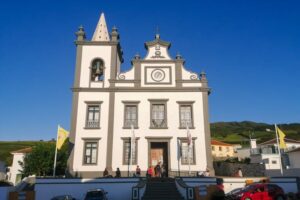
Serreta, or where the inhabitants of Terceira go every September „This weekend we’re going to Serreta, do you want to go with us?” – my friend asked me a few days ago. I wanted to. I put on comfortable shoes, sunglasses, packed my backpack with food, water, sweatshirt and raincoat – and off you go. Serreta is a Terceiran Częstochowa (Quick explanation: Częstochowa is a Polish cult place where pilgrims go from all around the country every year). Every year, pilgrimages to Serreta take place. The inhabitants of Terceira wander to the sanctuary in Serreta from every part of the island. Some people even go around the island, making about 80 km on foot. Some people go to ask for something. Others to show gratitude for the past year. Others to meet friends, drink beer and eat bifana. (Bifana is the often mentioned bun with a cutlet, available in almost every tasca, i.e. a foodtruck). And to see the tourada à corda and pull for capinhas. This year, for obvious reasons, no great festival was organized. Usually there are tascas, music and fireworks. This year – only pilgrims wandering the streets of Terceira throughout the week. And a man with hand sanitizer at the entrance to the church. Nossa Senhora dos Milagres – Our Lady of Miracles In the Azores and in Portugal, Nossa Senhora dos Milagres, or Our Lady of Miracles, is highly revered. There is a sanctuary named after her in Serreta. There is a painting under the same invocation. It is said that this painting saved a priest who was running away from danger in the 17th century. As a thank you for that care, the priest built a chapel in which he placed the painting. It was in the area of today’s Serreta. After the priest’s death, the painting was transferred to a church in the nearby village of Doze Ribeiras. This image served the Terceiran people, as did the image of Our Lady of Częstochowa (PL: Matka Boska Częstochowska) for Poles. In the 17th century, Portugal was involved in the war between France and Spain, and Great Britain. Terceira, a small island, was virtually defenseless in this war. Residents turned to Our Lady of Miracles with a request for protection. They promised that if the island did not suffer any attack from the enemy, they would organize an annual festival in honor of Our Lady of Miracles. What they did. Festivals in honor of Our Lady of Miracles The first festival of the Festas da Nossa Senhora dos Milagres was held on September 11, 1764. In 1842, the church in Serreta was built, the miraculous painting was brought back to it – and since then, the festivals are held regularly. And since 2006, when the church was elevated to the rank of a sanctuary, the holidays have been even more sublime. These are religious and secular holidays that blend in with the image of the island. On the day of my planned pilgrimage, a friend asked me why I was not staying on the beach any longer. After all, the weather is beautiful and you could „get cooked” at home. I replied, „Because I’m going to Serreta.” And it was all clear. Serreta is local code, everyone knows what’s going on. Serreta connecting people Serreta Weekend is one of the biggest events during the summer of Terceira. It connects old and young, believers and non-believers, fun-oriented and calm ones. The phenomenon of Terceira is that you can really feel the equality of all people here. Festivals in Serreta are one of the occasions to experience this unity. There are no better or worse, they are all equally important and the equally warmly welcomed. Isn’t it the social bond that we want? The Azores Read more about Azores 2018-01-25 The Azores 10 places worth visiting in Terceira 10 places worth visiting in Terceira When I decided to describe 10 places worth visiting in Terceira, I thought: but there are many more places worth visiting here! Terceira is a small island (around 400 sq. m) but full of beauty. But I realize that not everybody has a privilege… 2018-06-04 The Azores Festas do Espírito Santo Festas do Espírito Santo – what’s that? Festas do Espírito Santo – the Holy Spirit’s festivities – are one of the most distinguishable Azorean traditions. Their history starts in the 17th century, when Holy Spirit’s cult appeared in mainland Portugal. Sources don’t tell about any specific date, they just suggest… 2018-08-25 The Azores Tourada à corda – bulls in Terceira Tourada à corda, or a story about bulls running on the streets I was with a Polish friend who was on Terceira on Erasmus, on a tourada. He spotted someone in a Legia shirt in the crowd (Legia is a Polish football team). He told me: „Milena, look, there’s a…
Capinha, tourada and bulls, i.e. Terceira tradition behind the scenes

I wrote recently that I took part in an event in which I didn’t expect to participate. Someone guessed it had something to do with bulls. That something – it was Festival de capinhas. Capinhas festival. It started with my friend João saying: „We have a capinhas festival on Friday, do you want to come?” To my surprise – I wanted to. I watched bulls running freely in the arena and capinhas, i.e. people who – as is used to say here – play with bulls. Including my friend João. I understood what so many Terceira people might see in such events. Adrenaline and emotions There is admiration for the bulls and for the capinhas. Adrenaline and emotions that go up even more when the bull jumps over the railings. Or when you see someone you know in the middle of the arena. Looking straight into the eyes of the bull running at him. I’ve already been to several Terceira traditional touradas à corda. (These are events where bulls run in the streets; I wrote about it in more detail in the article „Tourada à corda„). But it was my first time at the Capinhas festival. I even had to ask who the capinhas were, I didn’t know the word. I learned that capinhas are people who appear during the tourada on the way of the bull’s run and attract its attention. They annoy it, call out to another place. They use rags, umbrellas or hands for this. Yes, hands. Some people put them on the head of a bull and go around in circles with the bull. My friend João is known to fans of touradas as capinha After the festival, I thought you might be interested in what the „world of bulls” looks like behind the scenes. After all, many people come to Terceira because of the tourada! So I interviewed João and learned a lot of interesting things. How it all started We’re sitting down and starting talking. First, I’m asking João about his history with tourada and bulls. „I’m from Terceira, bulls are in my blood,” he’s replying. And he’s starting talking about the fact that as a child he used to go on touradas to watch his grandfather. His grandfather was a capinha, and he wanted that too. He was always curious what it was like to face a bull. Until the first time it finally happenned. „I went once – and it stayed that way.” I’m asking João what’s the role of capinhas during the tourada “Capinha’s task is to animate the tourada. Without capinhas, there’s no tourada. The bull runs back and forth on the street, nothing’s happening. People who like touradas also like capinhas and what we do. The role of capinhas is to entertain the tourada participants. I never thought about it that way. I thought capinhas go on tourada more for themselves than for the audience. And here’s a surprise. Though it’s undeniable that these are adrenaline-loving people come into this role. “We feel adrenaline. A flare shot – and you just feel it. We play with the bull, but it’s dangerous fun. We feel the breath of the bull close to us. It’s a danger, but it’s such a… good danger. „ To become a capinha you just have to want it And show up on a tourada. There’s no need to let anyone know in advance, tourada is an event open to everyone. However, many newcomers are turning to capinhas who are more familiar with the subject for help. The bull can weigh even a ton, it inspires fear and respect. Therefore, beginner daredevils are sometimes accompanied by capinhas with more experience. Tourists sometimes too, but it’s usually tourists who get hurt by the bull. Because they don’t know how to behave. And I would like to remind you (see the article „Tourada à corda„) that the insurance doesn’t cover damage caused by the bull. For your own safety, leave playing with bulls to people with more experience. The basic rule on tourada is safety Safety of people and bulls. Capinhas play with the bull, run around. But when they see that the bull is very dangerous, they don’t risk their lives. „This is not our livelihood,” says João. “We go on a tourada to have fun and entertain the audience, but we all want to go home. Professionals, for example, in Spain, are different. All their lives are bulls. We go to our work, leave it in the evening and go on a tourada. And we want to come back from tourada safe and sound. I’ve had four serious accidents, got hit on my head once, and passed out. The fewer accidents the better.” I’m asking about the bulls. And learning that capinhas and tourada organizers also keep the bulls safe. Some time ago, a bull would hit a wall with a horn, break the horn, and run on. Not now. Now in such a situation the bull is immediately taken from the street and cured. João also tells me that when capinhas see that someone in the public is putting the bull in danger, they react immediately and drag the bull away. “We want safety for the bull as well, not only for ourselves. The bull also has its rights.” I’m beginning to wonder how capinhas get prepared for touradas I’m hearing in an answer that their only preparation are possible „touradas” with cows – mothers of bulls. Grenadiers, or cattle breeders, want to know which cow will make a good mother for the next good bull. Good, meaning big and brave, which can be proudly exhibited on tourada. So they invite capinhas to such „cow touradas”. The capinhas train and the grenadiers learn which cow is worth investing in. The best bulls are selected for touradas Sometimes these are famous bulls. The ones who have already participated in many touradas and know how to react to capinhas and other people on the streets. At
Marralhinha – the most popular game in Terceira

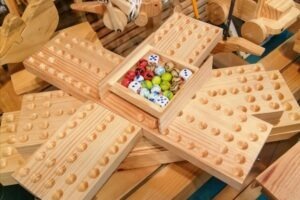
When I met my friends for the first time after the lockdown, a marralhinha entered the table. I usually yawn at 23:00 and that night I was sitting at the game until 2am, and my friends finished the tournament at 5am. Yes, you are thinking right – marralhinha draws in. Fortunately, not like Jumanji (although… if you look at 2020…), but it draws you in! Marralhinha is a typical game from Terceira. I got to know it paradoxically in Lisbon, when I was returning from Poland after Christmas. (It was also the first time I felt how terribly cold it is in the houses in Lisbon in winter). My friends had a visit of their friends, marralhinha appeared on the table. A wooden „board” with pits, marbles – and the evening was endless. This is a game that evokes emotions A fighting spirit awakens in calm people. Everyone wants to win, everyone creates a strategy in their head. And changes it after each dice roll. Because it’s a game in which strategy is mixed with statistics. Whoever has lost, willingly stands up for a rematch. Whoever won, starts the next games even more willingly. And so until morning. Marralhinha is a traditional game of Terceira There are two versions of the story of this game’s popularity in Terceira. One says that it was brought from the United States by a Terceira emigrant – in a version slightly different from the present one. The second version says that a similar game was very popular in one of the regions of France and from there it made its way to Terceira. How it really was – maybe one day we’ll find out. Maybe not. The lack of certainty as to the origin of the game does not prevent the inhabitants of the island from passionately playing it. There was even an Association of Party Games in Terceira established! The association regularly (of course, apart from the Jumanji year, i.e. 2020) organizes tournaments in which up to twenty teams play marralhinha (it is played in pairs). It’s really a lot of people for Terceira. You can buy Marralhinha in almost any souvenir shop. Or directly at handicraftsmen, for example at various handicraft fairs (they are organized, for example, on the occasion of Sanjoaninas LINK and Festas da Praia). If you only have carry-on luggage, make sure you select a game size that will fit in your luggage. My friends ended the first party after quarantine with a clear division into winners and all the rest, which pretended not to care about the loss. I’m kidding. Partly. Because there were clear winners. But the rest had a good time too. Me too. Until sleep got me down, but that’s another story. In the meantime – the principles of marralhinha! If you accidentally bought it and didn’t know how to play it. Or if you got a marralhinha as a gift. Like my family from me. With instructions in Portuguese. One and a half year ago… Marralhinha – rules of the game (Original rules in Portuguese HERE. Below – translation based on the rules version available on 30th of July, 2020) Two 2-person teams take part in the game. Each player has 5 marbles (10 marbles per team). Each player rolls a dice. The player with the highest score starts the game. The second player to his right is second (turn is going counterclockwise). In order for the marble to leave the starting fields, the player must roll 1 or 6 on the dice. The first player of any team, once (s)he has placed his/her five marbles in the end fields, continues play by helping his/her partner finish the game. When a 6 is rolled, the player must move the marble and roll the dice again. If, after rolling a 6, he/she places the last marble in the end fields, he/she rolls again to help his/her partner end the game. The player moves forward the number of spaces equal to the number on the dice. (Example: if you roll 5, you move the marble of your choice 5 spaces forward.) To enter or leave the center of the board, you must roll 1 or 6 dice. The square in the middle of the board is to help players shorten their path to the end fields. The center of the board can be entered from any of the three corners next to the center of the board (furthest from the end fields). When leaving the center of the board, the player must move to the corner closest to his end fields. (Here is my comment: according to the rules I learned, theoretically, you can move to other corners – but it doesn’t normally pay off, because the goal of the game is to reach the end fields as quickly as possible for both players). None of the five marbles of a player may overtake other marbles of the same player on the board. After playing a dice and picking up one of his marbles, the player is obliged to play this marble, unless he/she would make it to the square occupied by his/her partner’s marbles. If a player rolls 1 or 6 on the dice and picks up one of the marbles in the starting squares, and the starting field is not occupied by his or her partner’s marble, the player is obliged to put the marble into play (put it in the starting fields). In order to move the marble, a player must count the pits on the board, risking that his/her move will be canceled in the event of a mismatch. If during the movement of the marbles, the player gets to the field occupied by the opponent, he/she must gently touch the opponent’s marbles, remove it from the board and place it in the opponent’s starting field. The next player in line must wait with rolling the dice until the previous player has finished his/her move. If they the dice before their
Andreia and the best snacks in Biscoitos

I’m going to the booth and I can see that Andreia is smiling at me from afar. And she comments to her neighbour: „Do you know that I was in Poland without leaving Terceira?” Andreia is a very nice owner of a booth with local delicacies in Biscoitos. Third booth, counting from the bathing area. Everyone knows her there. They come to her to buy boiled corn, caramels, roasted peanuts or donuts. And for a good word and a smile that she gladly shares with everyone. I met her over three years ago. She always greets me with a smile and asks me how I feel. This time she’s noticing me and commenting to her neighbor: „Do you know that I was in Poland without leaving Terceira?” And she’s saying that one day a tourist came to her and said that they knew her in Poland. And he showed her a photo of her that I shared on the Facebook and on the Instagram. „See, you are famous in Poland!” – I’m starting to laugh. And I’m gettting an idea to interview Andreia. And write an article based on it. In the article you can say a lot more than in a short post on social media. So I’m going there on Monday morning with a list of questions and a charged phone, and I’m asking what she thinks about this idea. There is a mixture of joy and embarrassment on Andrea’s face. We’re sitting on the steps in front of the booth and starting talking. How did it start? 13 years ago Andreia went to the Feast of Emigrants (a large party in the center of Terceira) to sell boiled corn. But it was almost constantly raining, so she didn’t sell everything. Her dad gave her an idea that she could go with this sweet corn to the bathing area in Biscoitos. „Maybe you’re lucky there,” he said. And she was lucky. Andreia went to the bathing area in Biscoitos and stayed there. At the beginning, she shared her booth with a few men who didn’t quite accept a woman who’d be a business owner. They had some frictions, but in the end they learned to function with each other. Each of them was selling their own products. Andreia started with boiled corn, coscorões (one of the traditional carnival sweets) and roasted peanuts in caramel. With time, she added more products: pickles, vegetables and fruits from her garden, cupcakes. After about 5-6 years, she began selling donuts, which everyone loves so much today. With time, she also stayed alone in the booth, without the men that I mentioned earlier. The only men who occasionally appear in her booth on the salesman’s side are her husband and son. Business was developing slowly First, Biscoitos residents would come to Andrea. Satisfied, they talked about her products to their friends. Gradually, therefore, more and more inhabitants of the island began to appear at her booth. They came to Biscoitos for a walk, to spend a free afternoon with their family. They were glad that they could snack something good. Tourism was also gradually developing on the island. The number of tourists was increasing from year to year until 2019. (Although Andreia says that the best year in terms of business for her was 2018). Whoever arrives on the island is delighted with its beauty, lush greenery, blue sky and ocean. And they want to come back, they want to visit other islands. „More and more people are discovering our paradise in the middle of the ocean,” says Andreia. And what can you discover in Andrea’s booth? For me, Andrea’s booth is a cornucopia. There are plenty of goodies from Terceira and those that are eaten on Terceira. What does it mean? That next to the traditional Terceira cupcake Dona Amélia there’s an American donut, also loved by the inhabitants of the island. Hungry people skip this part. Earth gifts At Andrea’s booth you’ll find all the „gifts of the earth”: potatoes, tomatoes, zucchini, green beans, garlic, plums, apples, bananas, watermelons, passion fruit, oranges, tangerines… There are different fruiting seasons on the Azores, so something fresh can be found at any time of the year. Snacks For lovers of salty snacks, there are different types of peanuts (e.g. with garlic), fried pain, chips, boiled corn, rissóis (a type of dumplings with filling, baked or deep-fried), empadas (something like stuffed patties). If you like sweet snacks, you’ll find at Andrea’s traditional Terceira cupcakes Donas Amélias, a whole selection of other cupcakes (e.g. coconut, almond or… bean), peanuts with caramel or cinnamon, American donuts with sugar or icing, cakes, tarts or cookies – cinnamon, lemon, coconut and other . There are also filhadinhos – typical sweets from Alentejo. And of course, caramelos, or caramels, could not be missing. For the islanders it’s a taste of their childhood. Sweets their grandmother used to make when other sweets were not available. Caramels are difficult to prepare, Andreia herself says that she had many failed attempts. The results of the first attempts landed in the garbage. Until she learned. Today, both children and adults are happy to leave her booth with their package of caramels. A little bit of the carnival Andreia also shares the taste of the Terceira carnival with locals and tourists. Carnival on Terceira is celebrated much more than Christmas. Various traditions and snacks are associated with it. The most important out of the food are three types of sweets: filhoses do forno filled with lemon pudding, filhoses fritas – with a taste similar to donuts, and coscorões – they resemble Polish faworki, they are thin and crunchy. Everyone eats them during the carnival. Jars Finally, Andreia also prepares pickles and other products enclosed in jars. You can find honey from local bees. Pickles from sea fennel, boiled quail eggs and various vegetables. Massa de malagueta, or hot pepper sauce, which is one of the most popular hot spices on the island. Andreia also
Easter in Terceira

This is my fourth Easter on Terceira You sometimes ask me what Easter on Terceira looks like. I will tell you that it’s quite similar to the one in Poland. It’s primarily a religious but also a family holiday. It’s time to meet in a large group, with loved ones. Paschal Triduum Easter is a religious holiday, the most important in the Catholic Church. So it is celebrated above all in the church. Maundy Thursday – memory of the Last Supper On Maundy Thursday, the Mass of the Lord’s Supper is celebrated. It reminds us of the Last Supper and the establishment of the sacrament of priesthood. The rite of washing the feet, in turn, evokes the commandment of love. At the end of the mass, the Blessed Sacrament is moved from the altar to another secluded place. Good Friday is a holiday in Portugal Also in the sense that it is a day off from work. Can you imagine my surprise when in 2017 I went on Good Friday in search of a sour rye soup to an international store and this one was closed? Can’t you imagine? Then try to find this sour soup on Easter Monday. Impressions will be similar. Yes, except that in Portugal no one heard about this soup and the international store was my last resort. Traditionally, Good Friday applies „jejum e abstinência”, meaning fast and abstinence. What do they mean? Fasting means limiting the amount of meals consumed. It is now said that you can eat one full meal and small amounts of other meals. Abstinence is the quality limitation of meals consumed, with an indication of avoiding meat. Fish are allowed. (It is interesting that, according to the Church in Portugal, abstinence from meat affects all Fridays of the year, but I haven’t met yet a Portuguese who would comply. In fact, I haven’t met yet a Portuguese who would even know this recommendation. But everyone is surprised that such a tradition is respected in Poland). On Good Friday, the faithful also try to maintain abstinence from other meals and activities that may please them. Good Friday is a day without a mass. Instead, the liturgy of the word and adoration of the cross as a symbol of Christ’s death take place. And late in the evening – Via-sacra, i.e. the Way of the Cross on the streets of the city or village. Holy Saturday – without blessing eggs In Poland, Holy Saturday is associated with the preparation of Easter eggs and blessing of baskets. In Portugal, the Azores, Terceira – there is no such tradition. Holy Saturday is a day of silence, without a mass. Only in the evening, after dusk, do the faithful go to the most important Eucharist in the liturgical year – the Paschal Vigil. The Paschal Vigil. consists, like in Poland, of four liturgies. These are: liturgy of light – a sign of joy; as part of this liturgy, fire is blessed; the liturgy of the word – 9 readings: 7 from the Old Testament and 2 from the New Testament, at the end a solemn Hallelujah is sung; baptismal liturgy – renewal of baptismal vows; Eucharistic liturgy – receiving the Eucharist. Easter Sunday is a time for loved ones On Easter Sunday, the church bells ring as a sign of the Resurrection of Christ, and families gather for a lunch. The traditional Easter dish on Terceira is lamb. And the typical sweet bread massa sovada with egg on top. No one has heard of vegetable salad, eggs with mayonnaise or sour rye soup for breakfast. Everyone knows though that Easter on Terceira is a time for the family. It’s time to meet with loved ones. And giving them chocolate eggs (amendoins doces) in various versions. And in large quantities. Here, too, children eagerly look for eggs and sweets hidden in the home or garden (caça aos ovos), here everyone is also happy to be with their loved ones. You visit family and friends. It’s time to strengthen bonds. Especially since the celebration ends on Sunday, on Monday you already have to go to work. It’s necessary to make up for free Good Friday. And then – Festas do Espírito Santo In fact, Easter on Terceira is an introduction to Festas do Espírito Santo, the celebration of the Holy Spirit. This is a typical tradition for Terceira, which is celebrated to this day. Interested? Read more about it below. And be sure to come see it live! This is my fourth Easter on Terceira Each one was different. Once I made a typical Polish Easter breakfast for my friends from Terceira. They were so surprised by the amount of dishes with eggs! Yes, yes, Polish Easter is full of eggs. I once had a Polish-Spanish-Italian breakfast and an opportunity to learn about the traditions in other countries. My colleagues even prepared Easter eggs! And last year I spent Easter Sunday very actively with friends on the trail. 8000 steps passed at the first hill. Practically like Duracella bunnies. Now we have 2020 and the coronavirus stage Everything is closed, and from 9 to 13 April in Portugal no one can move between municipalities. On Terceira, too. Whoever lives in Angra cannot go to Prai at this time – and vice versa. The point is that people don’t go to Easter to their families and don’t infect each other. This year, for the first time, my Easter on Terceira will be in closed building. Like all other days at the moment. But I already have a sour rye soup in a package, I’m prepared! And besides having the sour soup, I also have a hope that the situation we’re in will soon improve. So that we can celebrate the last Sundays of Festas do Espírito Santo. I wish that for you and myself.
Sanjoaninas – the biggest festival in the Azores

The Sanjoaninas are the biggest profane festival in the whole Azores. It’s 10 days of celebrating St. John’s Day (St. John is in Portuguese São João) and Angra. And now short explanation of two things. The first thing – yes, it’s a profane festival, and yes, it’s a festival of St. John. It’s something like Midsummer Night in Poland – it also has pagan roots. The second thing – the Sanjoaninas are parties of Angra, the capital of Terceira. But everybody participates. The whole island, the whole archipelago, Portuguese from the mainland, tourists from all around the world. There’s enough place for everybody. The Sanjoaninas are a festival full of joy and local folklore. They date back to the XVI century. It means that the first habitants of Terceira started celebrating not long time after getting to the island. The form naturally evolved. In 1934, an opening courtroom with royal retinue showed up for the first time. It’s a tradition that survived until now. Every year a topic of the parade is chosen. It’s always connected with the history and tradition of the island. Every year there’s also a queen of the Sanjoaninas, chosen from local girls. She moves on a specially prepared platform and greets the audience. Around her there are also her courtiers, also on fancy platforms, and the whole retinue. During the Sanjoaninas you can also see numerous dancing groups and philharmonic orchestras. The volunteers dressed up in dashing and/or traditional costumes first train for weeks, then present themselves on the first night of Sanjoaninas. They flow through the streets of Angra, dancing and singing special songs prepared especially for Sanjoaninas. Behind them there’s usually an orchestra, also composed of volunteers, which plays the melody for the dancers. What is beautiful in these parades, also known as marchas, is that everybody can take part in them. You can see there the old, the young, the fat, the skinny, the tall, the shirt, the ones who can sing and the ones who are tone-deaf. The Sanjoaninas combine tradition, culture and gastronomy. On every corner you can see so called tascas (singular: tasca) – food/drink stalls. They are usually full of traditional local delicacies: morcela (local blood sausage), linguiça (local sausage), alcatra (something like stew), bifana (roll with chop), tremoços (lupin beans), lapas (limpets), steaks, fish… Yes, that’s right – mainly meat. There’s also a lot of beer. Microbeer. Small local beer has 0,2 l. they also drink wine and sangria here. And caipirinha – a delicious Brazilian drink based on cachaça – alcohol made of sugar cane. (If you want to drink great caipirinha, look for João’s tasca). And what about the culture and the tradition? I focused so much on food (it seems that I’m hungry!) that I’ve almost forgotten about the tradition and the culture. They are visible at every corner too. Because the Sanjoaninas – these are not only the parades, but also decorated streets, bedcovers hanging on the balconies and lots of activities. Concerts, sports events (regatta, kayak competitions, urban climbing, tennis tourneys, etc.), parades of different groups (e.g. scouts), theater shows on the stages and on the streets, exhibitions, handicraft fairs… At the Midsummer night, in the morning, there’s also jumping over the fire and eating sardines – fish almost as typical for Portugal as codfish. Of course there have to be also attractions connected to bulls. During the Sanjoaninas there are also traditionas touradas (I wrote about them in the article Tourada à corda), including tourada à corda in Porto Pipas – a port in Angra, bull runs in the streets and bull fights in arenas – with toreadors on the horses or without horses. These bull fights are the most controversional entertainment. The bulls in Portugal don’t get killed, but one can’t pretend that they are not getting hurt. However, there are still fewer opponents than supporters of it. As I mentioned – touradas are still one of the most important social events on the island. One works to live and does not live to work. Terceira’s habitants like having fun. There are numerous reason for celebration on the island, and the Sanjoaninas perfectly fit into the philosophy that one works to live and does not live to work. (St. John’s day is a holiday here!) As it is a small island with very limited chances of professional development, very few people commit themselves to their careers. Work is rather a source of income and social relations that self-actualization. Thereupon, the majority of people focuses on their private life. The Sanjoaninas, the Festas da Praia, the Carnival, touradas, Festas do Espírito Santo, festivities in all the villages – these are occasion for expressing joy and closening social bonds. And if you live in a small community, bonds are important. Well, if you live in a big community, they are important as well, but we tend to forget about it. And that’s a pity. Because – as my aunt usually says – the more the merrier. Which you can perfectly see during the Sanjoaninas, when sometimes it’s difficult to get from one side of the street to the other. And no, it’s not because the streets are as long as Aleje Jerozolimskie (one of the longest streets in Warsaw, the capital of Poland). It’s because every 5 steps you meet some friends. And chat. And suddenly you know where so much joy during the Sanjoaninas is coming from! I highly recommend it and I hope to see you there! PS You can look up the program of the Sanjoaninas HERE. if you had a problem with decoding Portuguese, let me know, I will help you if I can! 🙂
Dia de Amigos, i.e. Friends’ Day in the Azores

Dia de Amigos, Dia de Amigas, Dia de Compadres, Dia de Comadres… The last four Thursdays of the Carnival are extremely intensely celebrated in the Azores. Boyfriends’ (Male Friends’) Day, Girlfriends’ (Female Friends’) Day, Cofathers’ Day and Comothers’ Day are exceptional holidays, typical of the Azores archipelago. And still important, especially the first two. And how did it start? The history of celebrating these holidays is probably about 100 years old. The neighbors were gathering to prepare corn, wheat and other grains for the upcoming Festas do Espírito Santo, a celebration in honor of the Holy Spirit. In order not to get bored, they amused themselves with poetry and chants. Bonds between neighbours strengthened, and poems and musical pieces more and more eagerly praised friendship. After some time, traditional preparations for the Festas do Espírito Santo stopped having such meaning. Meetings in small groups were replaced by an organization at the commune level. Friends and acquaintances, however, were still eager to meet. Spending time together and celebrating friendship has become a value. Nowadays, Boyfriends’ (Male Friends’) Day and Girlfriends (Female Friends’) Day are one of the most celebrated holidays in Terceira. The fourth Thursday before the Carnival is Boyfriends’ Day. All the ladies stay at home, and groups of gentlemen come out on the streets of the island. These groups can include both three people and thirty – according to the principle „my friend’s friend is my friend”. Such meetings are an opportunity to break free from the routine of everyday life, to rest mentally and see those who have not seen each other for a long time. And for local dining outlets – to build up their budget. The third Thursday before the end of the Carnival belongs to ladies. Often fancifully, carnival-dressed groups of women celebrate Girlfriends’ Day just like men, in restaurants, bars and other places where you can eat and drink something good, and sometimes dance or… cheer on the stripper in his show. Yes, yes, striptease on Catholic, conservative islands is not surprising and it often accompanies Dia de Amigos and Dia de Amigas. I haven’t solved the puzzle yet, but… the machine on the street with condoms, lubricants and pregnancy tests is definitely part of the same puzzle. The Cofather’s Day and Comothers’ Day Day are more peaceful. They are usually commemorated by a text message with greetings or small sweets. But… who is a cofather? And who is a comother? Well, they are people of the same sex that have a big impact on raising a new society member. Cofathers are most often the father and the godfather of a child, and comothers – the mother and the godmother. On the islands, life still goes on in groups. Of course, Western European individualism is becoming more and more popular, but most of social life is still based on interpersonal contacts, especially those within the family. Family is holiness, and by the way – great help in everyday life. Sister will drop eggs and milk from a cow, brother – oranges, mother – freshly baked cake, cousins will take care of the child on Saturday afternoon – and you can function. And next Saturday, take over the queue to look after the cousins’ children. And give everyone interested beans from the garden behind the house. I don’t have beans behind the house, but I do function in a group of friends. And I celebrated Dia de Amigas three times on the island. There is something to celebrate! Friendship is one of the most beautiful inventions of humanity! Dia de Amigas means places filled with women full of good energy, it means streets full of chatty strollers, it means cars with smiley women faces… It’s good to see so much joy in the same time. And it’s even better to let yourself be carried away by this joy and to recharge your batteries with it for the next days. And if it ran out, you know – a phone call to a friend. Or a girlfriend!
Tourada à corda – bulls in Terceira

Tourada à corda, or a story about bulls running on the streets I was with a Polish friend who was on Terceira on Erasmus, on a tourada. He spotted someone in a Legia shirt in the crowd (Legia is a Polish football team). He told me: „Milena, look, there’s a guy in Legia’s shirt!” I wasn’t too conscious so I asked him what Legia’s shirt looks like. He explained, I spotted the man he was talking about and after a moment of hesitation we said: „Let’s go!” Nearby, there was a tasca (it’s kind of a foodtruck, seen here mainly at touradas and other special events), in which our countrymate was ordering something to drink. We told him „Good afternoon” and started a conversation. „What brought you to Terceira?” „I came to Terceira especially to see the bulls!” – answered our interlocutor. He amazed us enormously. We listened to his story: „I learned last year that there were bull runs in the Azores, and I wanted to see them. So I bought a ticket to the Azores and flew, but I got to São Miguel. And it wasn’t until I got there when I learned that I should have gone to Terceira. This year I came here.” I was very surprised that someone flew through half of Europe and half of the Atlantic Ocean in order to see how bulls run in the streets, but as I thought later about the reactions of various friends of mine to this phenomenon – I stopped being surprised. Touradas à corda are definitely one of Terceira’s distinguishing features. Bulls on the street are normal here At least from May 1 to October 15. During this period, touradas take place almost every day in one or more places. This means that the bulls, which are normally crowded in fields and pastures (right next to the cows, which are more numerous than people in the Azores), go out „into the street”. And they are more or less willing to meet the crowd of people gathered especially for them. Tourada à corda is an event that unites the community It’s a reason to meet, talk, spend time together. Lost wanderers will find a place on someone’s wall or even a yard. At this time, there are no differences between people – everyone wants to be safe and have the best perspective. To meet friends, laugh, hold your breath. Stay with each other in this exciting moment. What is the tourada à corda? Okay, so what’s the point? Well, the tourada à corda means bulls running along the street, held on a rope by two groups of 3-5 men each, called pastores (shepherds). The bull is usually mature and experienced in battle (although there are also younger and unfamiliar with the subject), and pastores – tough and hungry for adrenaline. And dressed in white shirts, gray or black pants and black hats. Daredevils annoy bull often equipped with umbrellas or sheets, and the entire spectacle is watched by the people gathered in the surrounding courtyards and fences. How to behave on tourada Before I mention the tradition of quinto touro, which is associated with the great hospitality of the inhabitants of Terceira and the unification of the community, maybe a few words about how to behave on tourada and what technical issues related to it look like. First of all – take care of your safety If your health and life are valuable to you, then you better watch out. Check in advance exactly where and when the tourada is taking place and appear there at least half an hour earlier. Tourada can be an exciting but also dangerous event. From the technical point of view – insurance doesn’t cover close meetings with a bull. If something happens to you, it is only your fault, so it’s better to take care of yourself in advance and find a place where you will definitely be safe. Second of all – leave the car away Leave the car far away (usually there will be no more places nearby anyway, all surrounding roads will be blocked) and come to the tourada by foot. Why? Well, so that by any chance your car doesn’t become interesting for a bull. No insurance will cover this for you. Tourada should not start if there are vehicles on its route, but it’s better not to risk it. Third of all – find a suitable place The bull usually runs along a street about 500 m long. If you want a good view, you have to find a place either along this street, on a safe (high!) wall or behind a fence. Most fences are protected with boards at this time – this applies to both private properties and tascas, i.e. the foodtrucks mentioned above, which are extremely popular during touradas. (Digression – you will buy in tascas beer, local liqueurs and aguardente, i.e. local moonshine, as well as bifanas, i.e. buns with a cutlet – the most popular local fast-food. And you will find peanuts, olives and lupine grains to be eaten. The owners of the tascas often offer their guests beer and don’t like „no” as an answer). If you don’t know where to hide – ask someone. Even if (s)he doesn’t speak English, (s)he’ll show you a safe place anyway. And if the bull is already on the street, and you haven’t found your place yet – stay where you are (as long as it’s not at the bull’s route). At the end of the bull’s „route” there’s a policeman and three white lines. Stay behind the third, which means a safety zone. Of course, unless the bull breaks from the rope etc. etc., but that’s another story. Fourth of all – listen to the sound signs Four bulls take part in the tourada, but they are not released at the same time. All bulls wait in their cages for their turn and are released one by one. Letting the bull
Festas do Espírito Santo

Festas do Espírito Santo – what’s that? Festas do Espírito Santo – the Holy Spirit’s festivities – are one of the most distinguishable Azorean traditions. Their history starts in the 17th century, when Holy Spirit’s cult appeared in mainland Portugal. Sources don’t tell about any specific date, they just suggest different possibilities – but they claim that the Holy Spirit’s cult arrived where the Portuguese arrived – to the Azores, Brasil and Canada. The first reports on the Holy Spirit’s feast celebration in Terceira come from 1492. Today Festas do Espírito Santo are celebrated only in the Azores. In mainland Portugal, maybe because of bigger contact with “the outside world” than on the islands, the tradition hasn’t survived. In the Azores, though, you can observe processions with crowns and meals for the whole village. Feasts are always concentrated around império – a small colourful Holy Spirit’s chapel. In Terceira there are over 70 of them, so no wonder that these feasts are celebrated so exceptionally here. Festas do Espírito Santo include the whole Easter time… …meaning the time from the Resurrection until Pentecost Sunday, and then – Trinity Sunday (one week after Pentecost Sunday). Each village or district connected to império has its own traditions. In many of them during the first six Sundays of the Easter time what is popular are processions with the Holy Spirit’s crown. Chosen people from the society are crowned, they get a silver tray as a symbol of the Holy Spirit and go in a procession to the house of the privileged family. In that house the Holy Spirit will stay for a week. Friends and family will gather there together to pray – and of course to eat. You can also see cows dressed up like brides. Usually there is music and singing, and numerous habitants of the village – and in such circumstances the cows are getting consecrated, and then, on Sunday, they become a meal for their owners and all the neighbours. If you show up in Terceira during Easter time, don’t get surprised if one Sunday somebody knocks on your door and give you bread or a bag with meat. Back then, food was distributed among the poor, today – among all the habitants. You should smile, politely say “thank you” and accept the gift. Festas do Espírito Santo is time of sharing, common feasting and common joy. Last Easter Sunday, and sometimes also Trinity Sunday, is one big feast for the whole society. There are crowds gathering around the chapels, you can get bread (standard one or the sweet one, which is popular here) to go, almost in bulk, and have an annual wine limit. Or cheese limit. Or boiled fava bean and other beans. You can look into carts decorated in white, standing in front of império, and check if there’s something interesting to eat inside. Or if you can rest there – with a piece of bread in one hand and wine in the other. While listening to the local orchestra. You can sit by a long table and get lucky to have some sopa do Espirito Santo – the Holy Spirit’s soup. It’s one of the typical soups from this region. It’s cooked on a meat stock with garlic and mint, and it contains mainly bread and cabbage. Sometimes on the tables you can also see cozido à portuguesa. It’s a cooked dish containing vegetables (mainly potatoes, in smaller amounts: carrots, cabbage and omnipresent beans) and different types of meat (mainly chicken, pork meat, beef, local chouriço, morcela – local blood sausage, and cubes of boiled blood – yes, it’s not a mistake). There’s also a dessert – arroz doce. It’s sweet rice boiled on milk, with cinnamon. You can also get juice as a dessert. Or even more wine. Festas do Espírito Santo is one of the traditions that hold the local society together. Everybody can be favoured by receiving the Holy Spirit to their house, there’s also a place for everybody by the long, full of food table. Also for lost, curios tourists. And nobody will ask you right at the beginning about your religion (nobody asks about it all, unless as an interesting cultural thing: “And how is it in Poland?”). Guests are welcome with opened arms. The Holy Spirit’s celebration is a celebration of unity and equity. As by the table that I mentioned, also in life everybody is equal and worth the same. The Azorean people know how to remind themselves about it. PS Of course Festas do Espírito Santo as a continuation of Easter wouldn’t be possible without… Easter.