
Serreta, or where the inhabitants of Terceira go every September

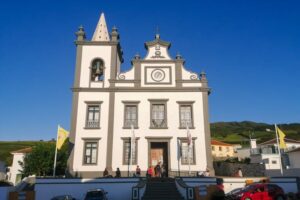
Serreta, or where the inhabitants of Terceira go every September „This weekend we’re going to Serreta, do you want to go with us?” – my friend asked me a few days ago. I wanted to. I put on comfortable shoes, sunglasses, packed my backpack with food, water, sweatshirt and raincoat – and off you go. Serreta is a Terceiran Częstochowa (Quick explanation: Częstochowa is a Polish cult place where pilgrims go from all around the country every year). Every year, pilgrimages to Serreta take place. The inhabitants of Terceira wander to the sanctuary in Serreta from every part of the island. Some people even go around the island, making about 80 km on foot. Some people go to ask for something. Others to show gratitude for the past year. Others to meet friends, drink beer and eat bifana. (Bifana is the often mentioned bun with a cutlet, available in almost every tasca, i.e. a foodtruck). And to see the tourada à corda and pull for capinhas. This year, for obvious reasons, no great festival was organized. Usually there are tascas, music and fireworks. This year – only pilgrims wandering the streets of Terceira throughout the week. And a man with hand sanitizer at the entrance to the church. Nossa Senhora dos Milagres – Our Lady of Miracles In the Azores and in Portugal, Nossa Senhora dos Milagres, or Our Lady of Miracles, is highly revered. There is a sanctuary named after her in Serreta. There is a painting under the same invocation. It is said that this painting saved a priest who was running away from danger in the 17th century. As a thank you for that care, the priest built a chapel in which he placed the painting. It was in the area of today’s Serreta. After the priest’s death, the painting was transferred to a church in the nearby village of Doze Ribeiras. This image served the Terceiran people, as did the image of Our Lady of Częstochowa (PL: Matka Boska Częstochowska) for Poles. In the 17th century, Portugal was involved in the war between France and Spain, and Great Britain. Terceira, a small island, was virtually defenseless in this war. Residents turned to Our Lady of Miracles with a request for protection. They promised that if the island did not suffer any attack from the enemy, they would organize an annual festival in honor of Our Lady of Miracles. What they did. Festivals in honor of Our Lady of Miracles The first festival of the Festas da Nossa Senhora dos Milagres was held on September 11, 1764. In 1842, the church in Serreta was built, the miraculous painting was brought back to it – and since then, the festivals are held regularly. And since 2006, when the church was elevated to the rank of a sanctuary, the holidays have been even more sublime. These are religious and secular holidays that blend in with the image of the island. On the day of my planned pilgrimage, a friend asked me why I was not staying on the beach any longer. After all, the weather is beautiful and you could „get cooked” at home. I replied, „Because I’m going to Serreta.” And it was all clear. Serreta is local code, everyone knows what’s going on. Serreta connecting people Serreta Weekend is one of the biggest events during the summer of Terceira. It connects old and young, believers and non-believers, fun-oriented and calm ones. The phenomenon of Terceira is that you can really feel the equality of all people here. Festivals in Serreta are one of the occasions to experience this unity. There are no better or worse, they are all equally important and the equally warmly welcomed. Isn’t it the social bond that we want? The Azores Read more about Azores 2018-01-25 The Azores 10 places worth visiting in Terceira 10 places worth visiting in Terceira When I decided to describe 10 places worth visiting in Terceira, I thought: but there are many more places worth visiting here! Terceira is a small island (around 400 sq. m) but full of beauty. But I realize that not everybody has a privilege… 2018-06-04 The Azores Festas do Espírito Santo Festas do Espírito Santo – what’s that? Festas do Espírito Santo – the Holy Spirit’s festivities – are one of the most distinguishable Azorean traditions. Their history starts in the 17th century, when Holy Spirit’s cult appeared in mainland Portugal. Sources don’t tell about any specific date, they just suggest… 2018-08-25 The Azores Tourada à corda – bulls in Terceira Tourada à corda, or a story about bulls running on the streets I was with a Polish friend who was on Terceira on Erasmus, on a tourada. He spotted someone in a Legia shirt in the crowd (Legia is a Polish football team). He told me: „Milena, look, there’s a…
Capinha, tourada and bulls, i.e. Terceira tradition behind the scenes

I wrote recently that I took part in an event in which I didn’t expect to participate. Someone guessed it had something to do with bulls. That something – it was Festival de capinhas. Capinhas festival. It started with my friend João saying: „We have a capinhas festival on Friday, do you want to come?” To my surprise – I wanted to. I watched bulls running freely in the arena and capinhas, i.e. people who – as is used to say here – play with bulls. Including my friend João. I understood what so many Terceira people might see in such events. Adrenaline and emotions There is admiration for the bulls and for the capinhas. Adrenaline and emotions that go up even more when the bull jumps over the railings. Or when you see someone you know in the middle of the arena. Looking straight into the eyes of the bull running at him. I’ve already been to several Terceira traditional touradas à corda. (These are events where bulls run in the streets; I wrote about it in more detail in the article „Tourada à corda„). But it was my first time at the Capinhas festival. I even had to ask who the capinhas were, I didn’t know the word. I learned that capinhas are people who appear during the tourada on the way of the bull’s run and attract its attention. They annoy it, call out to another place. They use rags, umbrellas or hands for this. Yes, hands. Some people put them on the head of a bull and go around in circles with the bull. My friend João is known to fans of touradas as capinha After the festival, I thought you might be interested in what the „world of bulls” looks like behind the scenes. After all, many people come to Terceira because of the tourada! So I interviewed João and learned a lot of interesting things. How it all started We’re sitting down and starting talking. First, I’m asking João about his history with tourada and bulls. „I’m from Terceira, bulls are in my blood,” he’s replying. And he’s starting talking about the fact that as a child he used to go on touradas to watch his grandfather. His grandfather was a capinha, and he wanted that too. He was always curious what it was like to face a bull. Until the first time it finally happenned. „I went once – and it stayed that way.” I’m asking João what’s the role of capinhas during the tourada “Capinha’s task is to animate the tourada. Without capinhas, there’s no tourada. The bull runs back and forth on the street, nothing’s happening. People who like touradas also like capinhas and what we do. The role of capinhas is to entertain the tourada participants. I never thought about it that way. I thought capinhas go on tourada more for themselves than for the audience. And here’s a surprise. Though it’s undeniable that these are adrenaline-loving people come into this role. “We feel adrenaline. A flare shot – and you just feel it. We play with the bull, but it’s dangerous fun. We feel the breath of the bull close to us. It’s a danger, but it’s such a… good danger. „ To become a capinha you just have to want it And show up on a tourada. There’s no need to let anyone know in advance, tourada is an event open to everyone. However, many newcomers are turning to capinhas who are more familiar with the subject for help. The bull can weigh even a ton, it inspires fear and respect. Therefore, beginner daredevils are sometimes accompanied by capinhas with more experience. Tourists sometimes too, but it’s usually tourists who get hurt by the bull. Because they don’t know how to behave. And I would like to remind you (see the article „Tourada à corda„) that the insurance doesn’t cover damage caused by the bull. For your own safety, leave playing with bulls to people with more experience. The basic rule on tourada is safety Safety of people and bulls. Capinhas play with the bull, run around. But when they see that the bull is very dangerous, they don’t risk their lives. „This is not our livelihood,” says João. “We go on a tourada to have fun and entertain the audience, but we all want to go home. Professionals, for example, in Spain, are different. All their lives are bulls. We go to our work, leave it in the evening and go on a tourada. And we want to come back from tourada safe and sound. I’ve had four serious accidents, got hit on my head once, and passed out. The fewer accidents the better.” I’m asking about the bulls. And learning that capinhas and tourada organizers also keep the bulls safe. Some time ago, a bull would hit a wall with a horn, break the horn, and run on. Not now. Now in such a situation the bull is immediately taken from the street and cured. João also tells me that when capinhas see that someone in the public is putting the bull in danger, they react immediately and drag the bull away. “We want safety for the bull as well, not only for ourselves. The bull also has its rights.” I’m beginning to wonder how capinhas get prepared for touradas I’m hearing in an answer that their only preparation are possible „touradas” with cows – mothers of bulls. Grenadiers, or cattle breeders, want to know which cow will make a good mother for the next good bull. Good, meaning big and brave, which can be proudly exhibited on tourada. So they invite capinhas to such „cow touradas”. The capinhas train and the grenadiers learn which cow is worth investing in. The best bulls are selected for touradas Sometimes these are famous bulls. The ones who have already participated in many touradas and know how to react to capinhas and other people on the streets. At
This Carnival was different

This Carnival was different. It was the first real Carnival in my life. I’ve been living in Terceira since January 2017, so this Carnival was the fourth during my life on the island. I still remember the first one. Everyone was telling: “You have to go to the Carnival”, and I was stiffening when I heard the phrase “you have to”. I didn’t feel like having fun. I was missing my family as hell and I felt more like sitting down and crying than celebrating. But I eventually put on a make-up as for Halloween and I went there. I walked among dressed up, smiling people, I took some photos. I went also to see balinhos, although my Portuguese was rather measly at that time, so I couldn’t understand a word from the shows. I tried filhoses do forno and filhoses fritas. And I decided that I liked bailinhos and filhoses, but costume parties were not for me. And this year I thought: the Carnival = party And after all, I like parties. I like meeting friends, I like having good fun. A friend proposed to meet in a group of friends and go to the party to Rua de Sāo Joāo. (A party which is apparently the last years’ invention, but it found its sympathizers very quickly). So we met, dressed up and went to the party. And it turned out that it was possible to go and to have fun! Ok, a small explanation – for me a party on a street is interesting for the first two hours. Later it gets boring, because neither you can dance (the music leaves a lot to be desired, maybe that’s why nobody dances here) nor talk (because it’s too loud). But the first two hours are worth experiencing them. The Carnival – what does it mean? Ok, a party is there, but generally – what does this Carnival mean? Lately I was looking for information about the Carnival to tell you about it on the Facebook and Instagram. And of course here, on the blog. I got to know that the word “carnival” comes from the Italian word “carnevale”. And that word has its Latin origin – of course! When you read what it means, your life will never be the same again. Are you ready? “Carnival” from Latin means “remove meat” or “farewell to meat”. Can you imagine? Steaks straight from the “Madagascar” instead of the Venice masks. Such a preparation for the Lent. I’ll leave you with that image. When you bounce back, you can continue reading. The Carnival in Terceira Are you still here, are you breathing? Good, now there will be something calmer. We’ll also get into the history, but a bit more recent. The end of the 19th century / the beginning of the 20th century. In the whole Europe dance shows were very popular. Groups known today as bailinhos evolved out of those dance shows. There are many theories about the origin of bailinhos. One of them tells that these were the emigrants coming back from Brasil that introduced a plot to the dance shows. Was it really like that? Probably we’ll never know it. But it’s nice to think that the local traditions have something in common with the amous Carnival in Rio. Bailinhos – a unique tradition from Terceira We know though that bailinhos are a tradition that exists only in Terceira. Bailinhos are stage groups that prepare their shows especially for the Carnival. Most of the groups consists of 20-24 people, usually amateurs. Each of the groups has to prepare its own script and arrangement to a typical music (rarely – writes their own music). Each team is also responsible for their costumes, make-up, scenography, stage props, logistics. Not even mentioning the choreography and direction. They start rehearsals a few weeks earlier. All that to play during the Carnival four days in a row in front of thousands of people. – Pedro, you all on this island wouldn’t work, you would only prepare some festivals all the time!– And do you have any idea how much work it takes to prepare a festival?? What do bailinhos talk about? The bailinhos performances are extremely popular. Around 60 groups visit every year around 40 culture centers located on the island and play in front of thousands of people. What do they talk about? About everything that during that time moves the local and international community. There may appear such issues as the government, health services, racial prejudices, low-cost airlines. There are also such topics as homosexuality, gender equality, betrayal, alcohol, limited transportation within the archipelago, rivalry between the islands, politics, inefficiency of courts, disputes between neighbours, climate changes. And many, many more. To understand bailinhos is to understand the island To understand well the bailinhos performances, you have to first of all speak Portuguese well and second of all – understand the local community. Jokes are simple but they hit into what the audience is interested in. From these performances you can read perfectly what the island’s community lives on. It’s a mirror of reality, it’s worth looking into it. In the article „Big Carnival in small Terceira” I wrote about how much I was surprised at the beginning by the lack of any plan and „schedule” of performances. I am not surprised anymore. Now I see that this is a part of culture. Just like following one bailinhos group like your favourite rock band. Or like eating bifana, broad beans and filhoses during breaks. Bailinhos performances are the largest „gathering” of popular theater in Portuguese language in the whole world. And all that on a small island. People wait for the Carnival for the whole year During the carnival, the habitants are eagerly celebrating Dia de Amigos, Amigas, Compadres and Comadres. Recently also bailinhos for the elderly, which takes place before the main Carnival weekend, is also popular. But these are the last 4 days that are the most important. People
Big Carnival in small Terceira

Carnival in Terceira – a big carnival on a small island Carnival (in Portuguese: Carnaval) is one of the events that the islanders are waiting for all year. And the moment it’s over – they cure a cold and wait for the next one. And next. And next. It is a tradition that is definitely worth looking at. I will lead you through it with my eyes. „You have to go to the carnival” – I hear. But how do I have to? Carnival is just a carnival, every occasion to celebrate is good and I don’t feel like celebrating right now. And how is it – that the carnival lasts from Saturday to Tuesday? And that Tuesday (Shrovetide) is supposedly a day off just because there is a party? And some public institutions also have a day off Monday? What the hell? But fine. I’m putting on a leather dress, I’m drawing a black spider’s web around my eyes and I’m going out. I hear later that my outfit was more suited to Halloween than to carnival. That it is gloomy at Halloween and wild and colourful at carnival. But that’s okay, I’m going to check what’s all the fuss about. Before leaving the bar of a friend, I still see a boy in a pink ballet skirt and pink tulle wings. I’m going out. I’m going to Rua de São João. And there’s a real party there. Rua de São João is one of the streets leading from the main street Rua da Sé to the marina in Angra. During the carnival (just like during Sanjoaninas) it becomes the party center of the island. Everyone who loves costume parties gets here. Especially on the last Saturday and… Monday of the carnival. Yes, Monday – eventually, Tuesday is a day off and you can sleep. Creating a fancy, original costume is a challenge that many people gladly take on. They try, buy, order, sew, knit, cut, glue, paint… The more expressively and colourfully, the better. On the streets you can see witches, pirates, frogs, knights, trees, and even Frida Kahlo. „That’s why in the stores they had all these Spiderman and maids costumes, and masks, and hats in all sorts of colours and shapes,” I’m thinking. And I’m watching groups of laughing people who party as if it was the best party of their lives. Who knows, maybe it is. The next best one will be on Monday. Another one – during the Sanjoaninas. And then again the carnival. I’m walking and looking at people. I am not in a fun mood at the end of February 2017, the beginning of my stay on the island, when I don’t know what and how, I feel how different I am. There is a crowd on the street, but somehow I can’t get lost in this crowd. I come back home feeling that this is a fantastic tradition, but not mine. Maybe someday I’ll get to her, maybe not. But it’s definitely an event worth seeing. Bailinhos, though, conquer my heart. Everyone around is also talking about bailinhos. And everyone is surprised that I do not know what it is. Well, this is a typical Terceira tradition, so it’s no surprise I don’t know it. But I get to know it quickly. Bailinhos are theater, music and dance groups, composed mainly of amateurs, which are created especially for the carnival period (last weekend, from Saturday to Tuesday). Original scenarios, music, choreographic arrangements, specially sewn costumes in all colours of the rainbow, long weekend and evening rehearsals… All this in order to drive for four days from one cultural center to another and comment on contemporary social and political reality from the stage. Both local, understandable only to the inhabitants of the island or even a commune, and worldwide. Sometimes there are professionals in the groups, but usually bailinhos are people who have their other work and occupancies – and only for the carnival period they put on a colourful costume and enter the stage. Some invariably every year for two decades. Or longer. Because it’s an addictive activity. Before this happens, however, bailinhos will have long weeks of preparation. Carnival is such an important event that even test dates in schools are sometimes postponed because of it! My first contact with bailinhos consists mainly of questions starting with „But how is it possible?” But how is it possible that there is no schedule? But how is it possible that no one knows when the next group will come? And who will be the next group? But how is it possible that you have no idea how long it will last? But how is it possible that you have food and drink, and blankets? Are you really going to sit here from the afternoon until the very morning?? During the first experience with bailinhos, I didn’t understand not only a word from the stage, but I also didn’t understand the whole cultural context. In small and larger cultural centers, people come as soon as possible, take their seats, put on a blanket and sit in fact from the afternoon until the dawn. They watch one performance after another, comment, compare to what the same group showed last year. They wonder which bailinhos are the most interesting this year, evaluate the set and costumes, wait impatiently for their neighbour, daughter or fish seller to appear on the stage. They go to the bar to eat bifana and treat each other with biscuits. Yes, there is a bar next to each cultural center during the carnival, where you can buy a bifana (a roll with a cutlet I mentioned several times, the absolute hit of each event), beer and other drinks and snacks. Besides, everyone is usually well stocked with chips, biscuits and orangeade. Carnival is not the time for healthy eating. Unfortunately, this trend has not arrived on the island yet. But many bacteria and viruses arrive to the carnival. It is
Dia de Amigos, i.e. Friends’ Day in the Azores

Dia de Amigos, Dia de Amigas, Dia de Compadres, Dia de Comadres… The last four Thursdays of the Carnival are extremely intensely celebrated in the Azores. Boyfriends’ (Male Friends’) Day, Girlfriends’ (Female Friends’) Day, Cofathers’ Day and Comothers’ Day are exceptional holidays, typical of the Azores archipelago. And still important, especially the first two. And how did it start? The history of celebrating these holidays is probably about 100 years old. The neighbors were gathering to prepare corn, wheat and other grains for the upcoming Festas do Espírito Santo, a celebration in honor of the Holy Spirit. In order not to get bored, they amused themselves with poetry and chants. Bonds between neighbours strengthened, and poems and musical pieces more and more eagerly praised friendship. After some time, traditional preparations for the Festas do Espírito Santo stopped having such meaning. Meetings in small groups were replaced by an organization at the commune level. Friends and acquaintances, however, were still eager to meet. Spending time together and celebrating friendship has become a value. Nowadays, Boyfriends’ (Male Friends’) Day and Girlfriends (Female Friends’) Day are one of the most celebrated holidays in Terceira. The fourth Thursday before the Carnival is Boyfriends’ Day. All the ladies stay at home, and groups of gentlemen come out on the streets of the island. These groups can include both three people and thirty – according to the principle „my friend’s friend is my friend”. Such meetings are an opportunity to break free from the routine of everyday life, to rest mentally and see those who have not seen each other for a long time. And for local dining outlets – to build up their budget. The third Thursday before the end of the Carnival belongs to ladies. Often fancifully, carnival-dressed groups of women celebrate Girlfriends’ Day just like men, in restaurants, bars and other places where you can eat and drink something good, and sometimes dance or… cheer on the stripper in his show. Yes, yes, striptease on Catholic, conservative islands is not surprising and it often accompanies Dia de Amigos and Dia de Amigas. I haven’t solved the puzzle yet, but… the machine on the street with condoms, lubricants and pregnancy tests is definitely part of the same puzzle. The Cofather’s Day and Comothers’ Day Day are more peaceful. They are usually commemorated by a text message with greetings or small sweets. But… who is a cofather? And who is a comother? Well, they are people of the same sex that have a big impact on raising a new society member. Cofathers are most often the father and the godfather of a child, and comothers – the mother and the godmother. On the islands, life still goes on in groups. Of course, Western European individualism is becoming more and more popular, but most of social life is still based on interpersonal contacts, especially those within the family. Family is holiness, and by the way – great help in everyday life. Sister will drop eggs and milk from a cow, brother – oranges, mother – freshly baked cake, cousins will take care of the child on Saturday afternoon – and you can function. And next Saturday, take over the queue to look after the cousins’ children. And give everyone interested beans from the garden behind the house. I don’t have beans behind the house, but I do function in a group of friends. And I celebrated Dia de Amigas three times on the island. There is something to celebrate! Friendship is one of the most beautiful inventions of humanity! Dia de Amigas means places filled with women full of good energy, it means streets full of chatty strollers, it means cars with smiley women faces… It’s good to see so much joy in the same time. And it’s even better to let yourself be carried away by this joy and to recharge your batteries with it for the next days. And if it ran out, you know – a phone call to a friend. Or a girlfriend!
Tourada à corda – bulls in Terceira

Tourada à corda, or a story about bulls running on the streets I was with a Polish friend who was on Terceira on Erasmus, on a tourada. He spotted someone in a Legia shirt in the crowd (Legia is a Polish football team). He told me: „Milena, look, there’s a guy in Legia’s shirt!” I wasn’t too conscious so I asked him what Legia’s shirt looks like. He explained, I spotted the man he was talking about and after a moment of hesitation we said: „Let’s go!” Nearby, there was a tasca (it’s kind of a foodtruck, seen here mainly at touradas and other special events), in which our countrymate was ordering something to drink. We told him „Good afternoon” and started a conversation. „What brought you to Terceira?” „I came to Terceira especially to see the bulls!” – answered our interlocutor. He amazed us enormously. We listened to his story: „I learned last year that there were bull runs in the Azores, and I wanted to see them. So I bought a ticket to the Azores and flew, but I got to São Miguel. And it wasn’t until I got there when I learned that I should have gone to Terceira. This year I came here.” I was very surprised that someone flew through half of Europe and half of the Atlantic Ocean in order to see how bulls run in the streets, but as I thought later about the reactions of various friends of mine to this phenomenon – I stopped being surprised. Touradas à corda are definitely one of Terceira’s distinguishing features. Bulls on the street are normal here At least from May 1 to October 15. During this period, touradas take place almost every day in one or more places. This means that the bulls, which are normally crowded in fields and pastures (right next to the cows, which are more numerous than people in the Azores), go out „into the street”. And they are more or less willing to meet the crowd of people gathered especially for them. Tourada à corda is an event that unites the community It’s a reason to meet, talk, spend time together. Lost wanderers will find a place on someone’s wall or even a yard. At this time, there are no differences between people – everyone wants to be safe and have the best perspective. To meet friends, laugh, hold your breath. Stay with each other in this exciting moment. What is the tourada à corda? Okay, so what’s the point? Well, the tourada à corda means bulls running along the street, held on a rope by two groups of 3-5 men each, called pastores (shepherds). The bull is usually mature and experienced in battle (although there are also younger and unfamiliar with the subject), and pastores – tough and hungry for adrenaline. And dressed in white shirts, gray or black pants and black hats. Daredevils annoy bull often equipped with umbrellas or sheets, and the entire spectacle is watched by the people gathered in the surrounding courtyards and fences. How to behave on tourada Before I mention the tradition of quinto touro, which is associated with the great hospitality of the inhabitants of Terceira and the unification of the community, maybe a few words about how to behave on tourada and what technical issues related to it look like. First of all – take care of your safety If your health and life are valuable to you, then you better watch out. Check in advance exactly where and when the tourada is taking place and appear there at least half an hour earlier. Tourada can be an exciting but also dangerous event. From the technical point of view – insurance doesn’t cover close meetings with a bull. If something happens to you, it is only your fault, so it’s better to take care of yourself in advance and find a place where you will definitely be safe. Second of all – leave the car away Leave the car far away (usually there will be no more places nearby anyway, all surrounding roads will be blocked) and come to the tourada by foot. Why? Well, so that by any chance your car doesn’t become interesting for a bull. No insurance will cover this for you. Tourada should not start if there are vehicles on its route, but it’s better not to risk it. Third of all – find a suitable place The bull usually runs along a street about 500 m long. If you want a good view, you have to find a place either along this street, on a safe (high!) wall or behind a fence. Most fences are protected with boards at this time – this applies to both private properties and tascas, i.e. the foodtrucks mentioned above, which are extremely popular during touradas. (Digression – you will buy in tascas beer, local liqueurs and aguardente, i.e. local moonshine, as well as bifanas, i.e. buns with a cutlet – the most popular local fast-food. And you will find peanuts, olives and lupine grains to be eaten. The owners of the tascas often offer their guests beer and don’t like „no” as an answer). If you don’t know where to hide – ask someone. Even if (s)he doesn’t speak English, (s)he’ll show you a safe place anyway. And if the bull is already on the street, and you haven’t found your place yet – stay where you are (as long as it’s not at the bull’s route). At the end of the bull’s „route” there’s a policeman and three white lines. Stay behind the third, which means a safety zone. Of course, unless the bull breaks from the rope etc. etc., but that’s another story. Fourth of all – listen to the sound signs Four bulls take part in the tourada, but they are not released at the same time. All bulls wait in their cages for their turn and are released one by one. Letting the bull