Andreia and the best snacks in Biscoitos

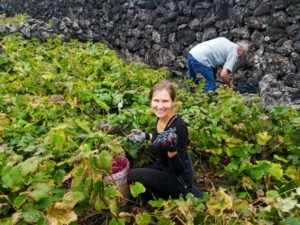
I’m going to the booth and I can see that Andreia is smiling at me from afar. And she comments to her neighbour: „Do you know that I was in Poland without leaving Terceira?” Andreia is a very nice owner of a booth with local delicacies in Biscoitos. Third booth, counting from the bathing area. Everyone knows her there. They come to her to buy boiled corn, caramels, roasted peanuts or donuts. And for a good word and a smile that she gladly shares with everyone. I met her over three years ago. She always greets me with a smile and asks me how I feel. This time she’s noticing me and commenting to her neighbor: „Do you know that I was in Poland without leaving Terceira?” And she’s saying that one day a tourist came to her and said that they knew her in Poland. And he showed her a photo of her that I shared on the Facebook and on the Instagram. „See, you are famous in Poland!” – I’m starting to laugh. And I’m gettting an idea to interview Andreia. And write an article based on it. In the article you can say a lot more than in a short post on social media. So I’m going there on Monday morning with a list of questions and a charged phone, and I’m asking what she thinks about this idea. There is a mixture of joy and embarrassment on Andrea’s face. We’re sitting on the steps in front of the booth and starting talking. How did it start? 13 years ago Andreia went to the Feast of Emigrants (a large party in the center of Terceira) to sell boiled corn. But it was almost constantly raining, so she didn’t sell everything. Her dad gave her an idea that she could go with this sweet corn to the bathing area in Biscoitos. „Maybe you’re lucky there,” he said. And she was lucky. Andreia went to the bathing area in Biscoitos and stayed there. At the beginning, she shared her booth with a few men who didn’t quite accept a woman who’d be a business owner. They had some frictions, but in the end they learned to function with each other. Each of them was selling their own products. Andreia started with boiled corn, coscorões (one of the traditional carnival sweets) and roasted peanuts in caramel. With time, she added more products: pickles, vegetables and fruits from her garden, cupcakes. After about 5-6 years, she began selling donuts, which everyone loves so much today. With time, she also stayed alone in the booth, without the men that I mentioned earlier. The only men who occasionally appear in her booth on the salesman’s side are her husband and son. Business was developing slowly First, Biscoitos residents would come to Andrea. Satisfied, they talked about her products to their friends. Gradually, therefore, more and more inhabitants of the island began to appear at her booth. They came to Biscoitos for a walk, to spend a free afternoon with their family. They were glad that they could snack something good. Tourism was also gradually developing on the island. The number of tourists was increasing from year to year until 2019. (Although Andreia says that the best year in terms of business for her was 2018). Whoever arrives on the island is delighted with its beauty, lush greenery, blue sky and ocean. And they want to come back, they want to visit other islands. „More and more people are discovering our paradise in the middle of the ocean,” says Andreia. And what can you discover in Andrea’s booth? For me, Andrea’s booth is a cornucopia. There are plenty of goodies from Terceira and those that are eaten on Terceira. What does it mean? That next to the traditional Terceira cupcake Dona Amélia there’s an American donut, also loved by the inhabitants of the island. Hungry people skip this part. Earth gifts At Andrea’s booth you’ll find all the „gifts of the earth”: potatoes, tomatoes, zucchini, green beans, garlic, plums, apples, bananas, watermelons, passion fruit, oranges, tangerines… There are different fruiting seasons on the Azores, so something fresh can be found at any time of the year. Snacks For lovers of salty snacks, there are different types of peanuts (e.g. with garlic), fried pain, chips, boiled corn, rissóis (a type of dumplings with filling, baked or deep-fried), empadas (something like stuffed patties). If you like sweet snacks, you’ll find at Andrea’s traditional Terceira cupcakes Donas Amélias, a whole selection of other cupcakes (e.g. coconut, almond or… bean), peanuts with caramel or cinnamon, American donuts with sugar or icing, cakes, tarts or cookies – cinnamon, lemon, coconut and other . There are also filhadinhos – typical sweets from Alentejo. And of course, caramelos, or caramels, could not be missing. For the islanders it’s a taste of their childhood. Sweets their grandmother used to make when other sweets were not available. Caramels are difficult to prepare, Andreia herself says that she had many failed attempts. The results of the first attempts landed in the garbage. Until she learned. Today, both children and adults are happy to leave her booth with their package of caramels. A little bit of the carnival Andreia also shares the taste of the Terceira carnival with locals and tourists. Carnival on Terceira is celebrated much more than Christmas. Various traditions and snacks are associated with it. The most important out of the food are three types of sweets: filhoses do forno filled with lemon pudding, filhoses fritas – with a taste similar to donuts, and coscorões – they resemble Polish faworki, they are thin and crunchy. Everyone eats them during the carnival. Jars Finally, Andreia also prepares pickles and other products enclosed in jars. You can find honey from local bees. Pickles from sea fennel, boiled quail eggs and various vegetables. Massa de malagueta, or hot pepper sauce, which is one of the most popular hot spices on the island. Andreia also
Five years ago

Five years ago I visited Terceira for the first time My friend took me straight from the airport to a trip around the island. Every 5 minutes I asked him to stop. I couldn’t stare. Everything amazed me. This was my first visit to the Azores I started exploring the islands of lost Atlantis from Terceira. I had learned about the island’s existence a few months earlier. And for a long time I wasn’t able to pronounce its name. When I came here, I thought I was crazy. I was flying to the middle of the Atlantic Ocean. To a small island. For 10 days. What will I do here for 10 days? Then it turned out that it was definitely not enough. On Terceira, for the first time in my life… Five years ago on Terceira I saw dolphins in their natural environment for the first time in my life. For the first time I ate octopus, snails, lapas (limpets) and cracas (barnacles). I was drinking vinho verde (green wine). I picked bananas in the backyard garden. I was riding a motorcycle. I watched bulls running on the streets. I was in the middle of a volcano. I visited lava tunnels. I took part in Sanjoaninas. I was drinking caipirinha. I washed ones again clothes that got wet while drying out. I was swimming in the ocean. I was walking along an empty riverbed. I drank wine in a local vineyard. Every day I asked what we would be doing the next day. And every day I heard it depends on the weather. I didn’t understand it. It seemed to me that you always had to have a plan. Today I know that it’s worth having a plan in the Azores, but later you need to adapt it to reality. Well… Not only in the Azores. Terceira was a discovery to me I saw a world different from the one I knew before. I saw that you can think differently. That you can smile at strangers. Enjoy what you have. Even if it’s not much. Even if I had never come back here – I would never forget this place anyway. The juicy colours of pristine nature would remain in me. The sound of the waves. Birds chirping. Human kindness. Ability to enjoy life. A visit to the Azores is an experience that leaves its permanent mark Of course, I urge you to see all the islands in the archipelago! But even if you visit only part of them, or maybe only one – you will come back home with a special mark in your heart. And I have a request for you – take care of this mark. Take care of beauty and goodness experienced in the Azores. Of respect for nature and for each other. Take care of it. Take a piece of the Azores with you to the world!
Angra do Heroísmo – the capital of Terceira on the UNESCO World Heritage List

Angra do Heroísmo is the capital of Terceira. Calm, charming, full of treasures to discover. Its historical center is inscribed on the UNESCO World Heritage List. If you were on Terceira, you were certainly walking around enchanted by the streets of Angra do Heroísmo. If you haven’t been – everything ahead of you! But before you get here, you can enjoy pictures of Angra. You can find them, for example, on Facebook and Instagram. In Angra you can feel as if we traveled back in time. Terceira was discovered and inhabited in the second half of the 15th century, and some buildings in Angra remember the early 16th century! So the first explorers or their children could walk on their corridors! Angra do Heroísmo on the UNESCO World Heritage List Angra do Heroísmo was inscribed on the UNESCO World Heritage List in 1983. The basis was two cultural criteria: • IV – the place has to be an outstanding example of a type of building, architectural or technological ensemble or landscape which illustrates (a) significant stage(s) in human history; • VI – the place has to be directly or tangibly associated with events or living traditions, with ideas, or with beliefs, with artistic and literary works of outstanding universal significance. (this criterion should preferably be used in conjunction with other criteria); When we look around Angra, we will see that history is present at every step here. Angra do Heroísmo is the first settlement in the Azores that received city rights. FIt’s been considered a city since 1534. In the same year, it became the seat of the diocese, which also affected its development. From the 16th to the 19th century it was the most important port of call in the Atlantic. Mostly for fleets sailing to and from India, but other ships crossing the Atlantic also stopped here. The ships were full of treasures from India and the Western world: gold, silver, oriental spices. They became the target of pirate attacks. Angry Bay, sheltered by the Monte Brasil peninsula, was a great haven. Two fortresses protected the island from external attacks: the São João Baptista fortress located by Monte Brazil and the fort São Sebastião (known as Castelinho) in Porto de Pipas („port of barrels”). Angra was developing, which was reflected in its architecture. The Sé cathedral, the Customs Office building, the church of Misericórdia (Mercy), the Franciscan convent – these are just some of the many monuments that confirm the importance of the capital of Terceira at that time. Angra do Heroísmo was also wisely built Angra is not only full of unusual monuments, but also very wisely built. When the first explorers reached Terceira, they saw the island with a large peninsula adjacent to its southern coast. The peninsula formed two bays and provided natural protection against wind and strong ocean waves. It is no wonder that they decided to settle there. The city grid is slightly skewed, comparing to the traditional buildings of those times. The first settlers built it, taking into account local winds, which indicates their great adaptation to the existing geographical conditions. Angra do Heroísmo has already survived the earthquake, may it survive also the following years On January 1, 1980, Terceira was hit by an earthquake of strength 7.2 on the Richter scale. Half of Angra was literally in ruins. However, most of the buildings were reconstructed according to their original plans. That is why today we can admire the unchanged shape of the historical center of the capital of Terceira. For those who have a house in the historical part of Angry, renovation work can be a trouble. You need to get a pile of permits, you need to keep the original facade, you need to remember about specific construction techniques. But when I walk the streets of Angry, I am grateful to the residents for their effort. It’s just beautiful here. Let it stay that way!
Souvenirs from the Azores

What are the souvenirs from the Azores that won’t occupy a lot of space in your luggage? Or even no space. Moreover, you can take these souvenirs from the Azores wherever you go. Wherever life leads you. I’ve prepared a list for you. I limited it to five items, but remember that this list doesn’t really have an end. You can add as many items as you can only imagine. So, shall we begin? 1. Slower pace. In the Azores life goes on at its own pace. When you go to a bar, a waiter will serve you only after having finished a conversation with a friend. Do you mind? Sit comfortable and inhale the smell of coffee and peace. Accept the reality as it is. Time goes slowly on the island and the interpersonal relationships are much more important here than business. If you switch on a flight mode, slow down a bit and let the island reality reorder your priorities – I can guarantee you that you will save a pleasant dose of the holiday freeness after having come back to the earth. 2. A memory of the ubiquitous greenery and sunsets over the ocean. The Azores are green. On 8 out of 9 islands of the archipelago there is a million shades of green. We owe it to high humidity and a big amount of rain. Yes, you’re reading correctly – this rain that can surprise you in every season the year is a direct reason of the breathtaking views of the fields and forests as from the scenery of “The Lord of the Rings”. The purest relief for the eyes and the heart. And the sunsets… There are never too many sunsets. One is enough for you to create a memory which will warm your heart. And each next will make the feeling stronger. Sometimes you may feel longing, but it’s worth longing such sunsets. 3. Flavour of fresh fish and sea food. Flavours are one of the souvenirs that stay with us for long years. Delicious codfish (a Portuguese national dish), grilled squids, freshly caught lapas (limpets) or boca negra (blackbelly rosefish) won’t let you forget about them. And if you add to them an octopus, cracas (not sure of an English name, probably barnacles – check their appearance at the photo below) and local tuna – you may not want to eat fish and sea food in any other place until the end of life. Maybe it’s not the best forecast for the future, but an experience – one of a kind. 4. Ocean. No, I’m not recommending packing the ocean into a backpack. But to take with you a soothing touch of water cuddling the whole body. To take its salty taste. A view of the waves crashing against the black volcanic rocks. A sound of the always alive, always flowing water. Ocean means life. Life for the marine fauna and flora, life for us. From your holidays take a bit of life with you! 5. Energy to start a new day. Regardless of the circumstances. Regardless of the plans. Of following them or making another revolution in your day. In the Azores the weather changes very often. Not without a reason there’s a saying that in the Azores you can have 4 seasons in one day. When it starts raining, nobody starts crying that they have to change their plans because of it. They just do it. And start a new activity with new energy. And it transfers to life. Changes of weather in the Azores can show you that it’s worth making plans but it’s not worth worrying when they don’t work out. It’s enough to stop for a new and make new ones. And start a new day with new energy. Or sometimes start a new phase of your life. Because if we already have a life, we’d better live it well. Even if it’s raining. There are my souvenirs from the Azores. The same that I brought from my first visit in the middle of the Atlantic Ocean. The same that I take with me whenever I’m leaving this place. They are with me. They help me live and enjoy life. These are the souvenirs from the Azores, which are in abundance for everybody. You just need to open your eyes and heart. There’s more than meets the eye. Have a good day! Have good memories!
Tourada à corda – bulls in Terceira

Tourada à corda, or a story about bulls running on the streets I was with a Polish friend who was on Terceira on Erasmus, on a tourada. He spotted someone in a Legia shirt in the crowd (Legia is a Polish football team). He told me: „Milena, look, there’s a guy in Legia’s shirt!” I wasn’t too conscious so I asked him what Legia’s shirt looks like. He explained, I spotted the man he was talking about and after a moment of hesitation we said: „Let’s go!” Nearby, there was a tasca (it’s kind of a foodtruck, seen here mainly at touradas and other special events), in which our countrymate was ordering something to drink. We told him „Good afternoon” and started a conversation. „What brought you to Terceira?” „I came to Terceira especially to see the bulls!” – answered our interlocutor. He amazed us enormously. We listened to his story: „I learned last year that there were bull runs in the Azores, and I wanted to see them. So I bought a ticket to the Azores and flew, but I got to São Miguel. And it wasn’t until I got there when I learned that I should have gone to Terceira. This year I came here.” I was very surprised that someone flew through half of Europe and half of the Atlantic Ocean in order to see how bulls run in the streets, but as I thought later about the reactions of various friends of mine to this phenomenon – I stopped being surprised. Touradas à corda are definitely one of Terceira’s distinguishing features. Bulls on the street are normal here At least from May 1 to October 15. During this period, touradas take place almost every day in one or more places. This means that the bulls, which are normally crowded in fields and pastures (right next to the cows, which are more numerous than people in the Azores), go out „into the street”. And they are more or less willing to meet the crowd of people gathered especially for them. Tourada à corda is an event that unites the community It’s a reason to meet, talk, spend time together. Lost wanderers will find a place on someone’s wall or even a yard. At this time, there are no differences between people – everyone wants to be safe and have the best perspective. To meet friends, laugh, hold your breath. Stay with each other in this exciting moment. What is the tourada à corda? Okay, so what’s the point? Well, the tourada à corda means bulls running along the street, held on a rope by two groups of 3-5 men each, called pastores (shepherds). The bull is usually mature and experienced in battle (although there are also younger and unfamiliar with the subject), and pastores – tough and hungry for adrenaline. And dressed in white shirts, gray or black pants and black hats. Daredevils annoy bull often equipped with umbrellas or sheets, and the entire spectacle is watched by the people gathered in the surrounding courtyards and fences. How to behave on tourada Before I mention the tradition of quinto touro, which is associated with the great hospitality of the inhabitants of Terceira and the unification of the community, maybe a few words about how to behave on tourada and what technical issues related to it look like. First of all – take care of your safety If your health and life are valuable to you, then you better watch out. Check in advance exactly where and when the tourada is taking place and appear there at least half an hour earlier. Tourada can be an exciting but also dangerous event. From the technical point of view – insurance doesn’t cover close meetings with a bull. If something happens to you, it is only your fault, so it’s better to take care of yourself in advance and find a place where you will definitely be safe. Second of all – leave the car away Leave the car far away (usually there will be no more places nearby anyway, all surrounding roads will be blocked) and come to the tourada by foot. Why? Well, so that by any chance your car doesn’t become interesting for a bull. No insurance will cover this for you. Tourada should not start if there are vehicles on its route, but it’s better not to risk it. Third of all – find a suitable place The bull usually runs along a street about 500 m long. If you want a good view, you have to find a place either along this street, on a safe (high!) wall or behind a fence. Most fences are protected with boards at this time – this applies to both private properties and tascas, i.e. the foodtrucks mentioned above, which are extremely popular during touradas. (Digression – you will buy in tascas beer, local liqueurs and aguardente, i.e. local moonshine, as well as bifanas, i.e. buns with a cutlet – the most popular local fast-food. And you will find peanuts, olives and lupine grains to be eaten. The owners of the tascas often offer their guests beer and don’t like „no” as an answer). If you don’t know where to hide – ask someone. Even if (s)he doesn’t speak English, (s)he’ll show you a safe place anyway. And if the bull is already on the street, and you haven’t found your place yet – stay where you are (as long as it’s not at the bull’s route). At the end of the bull’s „route” there’s a policeman and three white lines. Stay behind the third, which means a safety zone. Of course, unless the bull breaks from the rope etc. etc., but that’s another story. Fourth of all – listen to the sound signs Four bulls take part in the tourada, but they are not released at the same time. All bulls wait in their cages for their turn and are released one by one. Letting the bull
10 places worth visiting in Terceira

10 places worth visiting in Terceira When I decided to describe 10 places worth visiting in Terceira, I thought: but there are many more places worth visiting here! Terceira is a small island (around 400 sq. m) but full of beauty. But I realize that not everybody has a privilege to spend here as much time as I do. That’s why I chose “must see” places. And made sure that you won’t spend half a day looking for them. So, shall we start? 1. Volcano Algar do Carvão As it is my favourite place on the whole Island, of course it has to be on the first place. There are plenty of volcanoes on the Azores, but this one is unique. Why? Because you can see it from the inside! From the inside of the volcanic cone! What is it about? In most of the volcanoes, after the eruption the cone collapses and creates a caldera. Here it was different. Here during the second eruption which created the volcano, lava was flowing under such small pressure that as some point it started getting back. When it was getting back, it was strengthening the cone. That’s why the volcano, apart from undergoing natural changes, survived in the condition that we can admire until today. In Europe there are only two known empty volcanoes (in the whole world – three), which you can visit from the inside. This is Algar do Carvão in Terceira and Thrihnukagigur in Iceland. As you can see, the Atlantic Ocean favours untypical geological events. In Algar do Carvão you can see such unique work of nature as stalactites and stalagmites from amorphous silica. They are milk-white, beautiful and they may reach up to around 1 m of length and 40-50 cm in diameter. Visiting Algar do Carvão is now possible for the whole year. During winter – in chosen week days, since spring until autumn – every day. It’s worth getting dressed warmly because it’s cold inside and there is dropping water there (which creates a lagoon at the bottom of the cave). A standard visit takes around half an hour, although in my opinion it’s worth planning at least an hour for this experience. There’s a guide inside the cave who will explain you everything and answer your questions. There also leaflets in different languages, including Polish. If you want to get to know more about the volcano, check the website of the Association Os Montanheiros, which takes care of the volcano. Website of the Association Os Montaheiros: HEREMore information about the volcano Algar do Carvão: HEREOpening hours and ticket prices: HERE 2. Lava tube Gruta do Natal As we’re already under ground, let’s visit also a lava tube Gruta do Natal. Some guides, wanting to help tourists, use the English name Christmas Cave. Where is this name coming from? Well, it started with a mess, which was organized by the Association Os Montaheiros (it also take care of this cave) during Christmas time in 1969. Since then, every now and again important historical and social events take place in this cave. Gruta do Natal is a cave shaped by flowing lava. Inside of it, you will see such lava curiosities as stafilites (“stalagmites” made of dropping lava), lava flows and lateral “counters”. There are also different kinds of lava there, including lava aa. Once I heard a story that it’s called like that because when you walk on it, you say: “Aa!” Its rough surface indeed provokes such sounds, I wouldn’t like to stand on it barefoot. Important logistic and payment information: you can buy one ticket to both the volcano Algar do Carvão and to Gruta do Natal, this way you will pay less. You don’t have to use the ticket on the same day, but before planning a visit it’s worth checking opening days and hours, to not go away empty-handed. More information about the lava tube Gruta do Natal: HEREOpening hours and ticket prices: HERE 3. Furnas do Enxofre Between the empty volcano and the lava tube there’s a place called Furnas do Enxofre. When you will be going from Algar do Carvão to Gruta do Natal, turn right, the road sign will lead you. “Furna” means a grot or a cave, “enxofre” – Sulphur, so theoretically Furnas do Enxofre are a grot of Sulphur, but in reality it’s an area of secondary volcanic activity in Terceira. You can see there and smell gas sulphur compounds plumming from the ground. Who remembers from chemistry classes what’s the smell of hydrogen sulphide? As befits a volcanic area, Furnas do Enxofre is a beautiful site with juicy greenery. (Volcanic soils are very fertile, and the Azorean climate is favourable for all kinds of vegetation). Apart from the fumaroles – places where gas is pluming from the Earth. There, because of huge concentration of iron and Sulphur, the soil is bare and has white-yellow-brownish colour. It can arouse small anxiety, but only small. Because if the gas can plume, it’s a bit calmer underground. The water in a pod is boiling, but a bit leaky lid let the steam “escape”, so the content of the pod shouldn’t suddenly boil over. 4. Santa Bárbara – the highest point in Terceira Let’s move up from the lowlands and undergrounds – maybe to the clouds? To the peak Serra de Santa Bárbara – the highest point of Terciera. It has 1021 m above sea level and you can see from there a big part of Terceira, the omnipresent ocean and incredible sunset. Of course if you get lucky and if St. Barbara is not hidden in clouds. The truth is that’s it’s the middle of the Atlantic ocean and the clouds, which flow fast, are being stopped by hills. So I suggest observing the weather and going to Serra de Santa Bárbara (it’s a very characteristic peak, with lots of antennas and transmitters) the moment you see its peak. It’s worth it! I have almost forgotten to