
Grape harvest, vineyards and wine – discovering paradise in Biscoitos

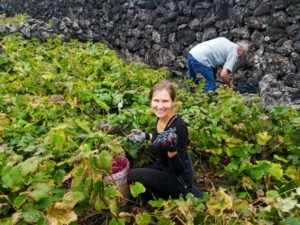
Grape harvest, vineyards and wine – discovering paradise in Biscoitos A few days ago I went to the grape harvest for the first time in my life. Thus, I fulfilled my dream from several years ago. What happened several years ago? Well, a dozen or so years ago I was walking among the vineyards in Germany. Delighted. Vast hills filled with rows of sun-ripened grapes. The gentle rustle of leaves. Something beautiful! I thought then: I want that too! I want to take part in the grape harvest too. I want to contribute to the wine! Years passed and I admired more vineyards as a guest I admired the vineyards in Biscoitos, admired the vineyards in Pico, listened to the stories about wine making in Porto, I even read articles about wine in Poland! And this year I started walking regularly among the vineyards. Not that I was doing it on purpose. Just my way to the beach ran through the vineyards. I saw them every day. And after a while – I started talking about them. With different people. One of these people was – as it turned out – the owner of one of the vineyards in Biscoitos. After a few talks, he invited me to participate in the grape harvest. I almost jumped with joy! I was asking at least once a week when was that day. And finally a few days ago the grape harvest took place. With my participation. I was overjoyed! I got up at dawn, dressed in black from head to toe (so that there would stay no stains from dark grapes) and set off on the adventure. I was given a bucket, a pair of gloves and a secateurs on the spot. And a brief instruction on which grapes should be cut and which ones shouldn’t be used. And I was ready to go! In the Azores, wine grows differently than in the vineyard I saw in Germany. The vines are not suspended on vertical structures here, but grow horizontally on black volcanic rocks. I wrote about why this is so in the article „Biscoitos wine„. Grapes hide under the leaves Before starting work, I looked around the vineyard. And I remembered my friend’s story about his first grape harvest. He said, “I looked down at the vine and I thought there weren’t any grapes there. But when I picked up the branch, I got surprised.” I smiled at that memory and squatted beside my first vine. I picked up a branch and saw a paradise. Beautiful purple bunches waited safely under the leaves for someone to take an interest in them. I got down to work. Buckets got filled one after the other I had to be very careful where I put my feet on loose volcanic stones. So I wouldn’t break my legs. And my exposed ankles were quickly all scratched with sharp vines. But I was working. Me and a dozen men with an average age of about 60-65 years. Buckets got filled one after the other. We poured their contents into large containers that a few of the stronger men carried onto car trailers. And so for several hours. Until all the grapes were harvested, all the containers were full, and it was possible to take the fruit to the adega, i.e. the wine house. The next day, the grapes were separated from the stalks and the fruit was squeezed out. I just watched this part of the process. The men used a machine specially built for this purpose to remove the stalks from the grapes. The juice was pressed in a large wooden press. The grapes were loaded into something like a barrel, which was pressed from above with pieces of wood. Imagine a hand jack but going down, not up. It was something like that. The juice flowed into a large basin, and from there it was pumped into huge stainless steel containers with a special device. Containers of 500 or 1000 liters. Of course, it wasn’t done on its own. It took a lot of work and sweat and a lot of grape juice stains on the shirts of the men working on it. Next year this wine will appear on the tables during Festas do Espírito Santo I have always wondered where the wine served during the celebration of the Holy Spirit holidays comes from. Now I know! And next year I will look for „our” wine! Some of the grape juice will be transformed into a local alcohol called angelica. I recently got a bottle of this, heaven in mouth! And what will happen to the stalks? The stalks will return to the ground as a fertilizer. Nothing can be wasted in this process! You never know There was one person about my age who was also involved in the grape harvest. Both my and his attention was drawn to the fact that all the other people are around 60-65 years old, maybe more. They are men with vast knowledge and vast experience. I hope they will live a long time, but I wondered what would happen to the vines in Terceira when they are gone. They say directly that local vines hardly make money. They deal with grapevines because that’s their whole life. All their knowledge is in their heads. They don’t have smart books, they just listen to plants. They know when to fertilize them, when to trim them, when to harvest. They know which varieties are resistant to the vines scourge, phylloxera, and which ones need to be grafted. They don’t hire people for the harvest, they help each other. They love the earth, they love vines. And despite their strength and enormous energy, they have more and more, not less, years. They asked me half-jokingly if I’m planning to buy a vineyard. I replied, „You never know.” The Azores Read more about Azores 2018-01-25 The Azores 10 places worth visiting in Terceira 10 places worth visiting in Terceira When I
Biscoitos wine

Everybody who visits Terceira has to get to know Biscoitos wine. Biscoitos is the only part of Terceira destined to wine production. A characteristic landscape of black stone walls and bright green vine leaves laying on them is even protected by the Azorean government. Biscoitos wine is an important part of the island’s heritage. The history of Biscoitos wine started in the 15th century… …which was the time of the colonization of the island. Already the first settlers used the volcanic soil for grapevine cultivation. In 1647 a wine Verdelho started to be commonly used. It’s a variety that adapted well to the humid conditions on the island. One of its features is a loose grapes cluster. Such clusters are less prone to rotting. Nothing is though 100% resistant to other plagues. In the 18th and 19th century different plagues attacked vineyards in Terceira. Among them there was also destructive phylloxera, which blasted also many other vineyards in the world. It was in 1890 when a crazy man, as they thought at that time, or a dreamer, as you can say now, Francisco Maria Brum, decided to reactivate wine production. He founded a vineyard! He started in Fontinhas and then moved to Biscoitos. This vineyard has been known as Casa Agrícola Brum. It’s been working uninterruptedly for almost 130 years, led by already the 5th generation of the same family. Still with the same passion! Biscoitos wine is volcanic wine Verdelho variety grows on a volcanic soil aming so called „biscoitos” („cookies”) – small volcanic Stones. This viticulture is different than the ones we know from for example France or Italy. In Terceira the future Biscoitos wine grows on little squares or rectangles surrounded by walls made of black volcanic rocks. Vines don’t ramp up along the lines, but sprawl over even more stones placed on the soil around them. Stone walls protect the vines from the cold salty wind blowing from the ocean, and the walls combined with the Stones that lay on the ground create a special microclimate. The stones warm up during the day and release the heat during the night. Thanks to that, the grapes ripen faster and produce more sugar. The Biscoitos wine, even the dry one, won’t make your face twitch. The view of the vineyard by the sea may make you smile dreamily though. In Biscoitos you can go for a trail among the vineyards and you can also visit the Wine Museum (Museu do Vinho dos Biscoitos) In 1990, at the 100th anniversary of its vineyard, the family Brom opened the Wine Museum in Biscoitos. In this museum you can get to know not only the history of the family Brum and their vineyard, but also the history of the island and of winemaking. You can also see the Verdelho wine variety (for the museum needs, exceptionally growing vertically) and try delicious wine. The traditional wine of this wine house is fortified wine Chico Maria (dry, semi-dry and sweet). For the table wine lovers there are Da Resistência and Donatário waiting. All of them matured in oak barrels before getting bottled and destined to sell. Yes, yes, if you like some wine, you can buy it on the premises and then relish the memories of your visit in Terceira for long time. Every year in the Wine Museum in Bisoitos there is a Fest of Vine and Wine from Biscoitos organized. On selected day in late August, at the Wine Museum, you can see people in traditional costumes picking grapes into traditional wicker baskets, participate in grape trampling, drink wine from clay pots, and try traditional Azorean snacks. There’s also always a celebration with music and dancing. Lately I visited the Wine Museum in Biscoitos with one of my friends. We got a tour guided by very nice representatives of the 4th generation of the family Brum. Together with them we admired the grapes asking for each sunray, winepresses and huge barrels giving hope for more liters of the delicious drink. Of course, it couldn’t have been without wine tasting! We tried delicious fortified wines and table wines with massa sovada – the traditional Portuguese sweet bread. Conversations and smiles would never stop. There must have been a reason why I included the Wine Museum on the list of the 10 places worth visiting in Terceira. Useful information Localization: Museu do Vinho dos Biscoitos is located on the North of the island, in Biscoitos, at Canada do Caldeiro 3. Opening days and hours: from Tuesday do Saturday, 1:30 p.m. – 4 p.m. How to get there: because of the wine tasting I recommend using the public transport; you will get there on the bus no. 1 from Angra (tell the driver “Biscoitos, Museu do Vinho”); you will find the schedule of the buses HERE. Entrance free Wine prices: depending on the type and year, around 10 to 40 EUR Recommendation: fortified wine Enjoy your visit and wine tasting! May the Biscoitos wine be with you!