
Five years ago

Azory, Azores, Terceira, trail, szlak, trilho, droga, caminho, estrada, Milena, las, drzewa

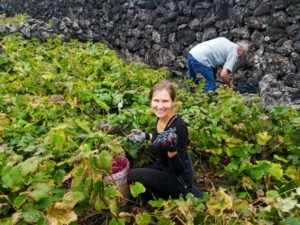
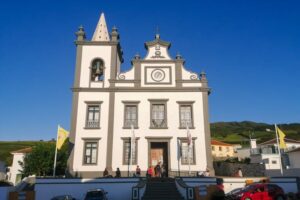
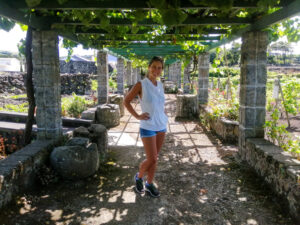
Five years ago I visited Terceira for the first time My friend took me straight from the airport to a trip around the island. Every 5 minutes I asked him to stop. I couldn’t stare. Everything amazed me. This was my first visit to the Azores I started exploring the islands of lost Atlantis from Terceira. I had learned about the island’s existence a few months earlier. And for a long time I wasn’t able to pronounce its name. When I came here, I thought I was crazy. I was flying to the middle of the Atlantic Ocean. To a small island. For 10 days. What will I do here for 10 days? Then it turned out that it was definitely not enough. On Terceira, for the first time in my life… Five years ago on Terceira I saw dolphins in their natural environment for the first time in my life. For the first time I ate octopus, snails, lapas (limpets) and cracas (barnacles). I was drinking vinho verde (green wine). I picked bananas in the backyard garden. I was riding a motorcycle. I watched bulls running on the streets. I was in the middle of a volcano. I visited lava tunnels. I took part in Sanjoaninas. I was drinking caipirinha. I washed ones again clothes that got wet while drying out. I was swimming in the ocean. I was walking along an empty riverbed. I drank wine in a local vineyard. Every day I asked what we would be doing the next day. And every day I heard it depends on the weather. I didn’t understand it. It seemed to me that you always had to have a plan. Today I know that it’s worth having a plan in the Azores, but later you need to adapt it to reality. Well… Not only in the Azores. Terceira was a discovery to me I saw a world different from the one I knew before. I saw that you can think differently. That you can smile at strangers. Enjoy what you have. Even if it’s not much. Even if I had never come back here – I would never forget this place anyway. The juicy colours of pristine nature would remain in me. The sound of the waves. Birds chirping. Human kindness. Ability to enjoy life. A visit to the Azores is an experience that leaves its permanent mark Of course, I urge you to see all the islands in the archipelago! But even if you visit only part of them, or maybe only one – you will come back home with a special mark in your heart. And I have a request for you – take care of this mark. Take care of beauty and goodness experienced in the Azores. Of respect for nature and for each other. Take care of it. Take a piece of the Azores with you to the world!

Easter in Terceira

Wielkanoc, Wielkanoc na Terceirze, Easter, Easter in Terceira, amendoins doces, czekoladki, jajka czekoladowe, chocolate eggs,

This is my fourth Easter on Terceira You sometimes ask me what Easter on Terceira looks like. I will tell you that it’s quite similar to the one in Poland. It’s primarily a religious but also a family holiday. It’s time to meet in a large group, with loved ones. Paschal Triduum Easter is a religious holiday, the most important in the Catholic Church. So it is celebrated above all in the church. Maundy Thursday – memory of the Last Supper On Maundy Thursday, the Mass of the Lord’s Supper is celebrated. It reminds us of the Last Supper and the establishment of the sacrament of priesthood. The rite of washing the feet, in turn, evokes the commandment of love. At the end of the mass, the Blessed Sacrament is moved from the altar to another secluded place. Good Friday is a holiday in Portugal Also in the sense that it is a day off from work. Can you imagine my surprise when in 2017 I went on Good Friday in search of a sour rye soup to an international store and this one was closed? Can’t you imagine? Then try to find this sour soup on Easter Monday. Impressions will be similar. Yes, except that in Portugal no one heard about this soup and the international store was my last resort. Traditionally, Good Friday applies „jejum e abstinência”, meaning fast and abstinence. What do they mean? Fasting means limiting the amount of meals consumed. It is now said that you can eat one full meal and small amounts of other meals. Abstinence is the quality limitation of meals consumed, with an indication of avoiding meat. Fish are allowed. (It is interesting that, according to the Church in Portugal, abstinence from meat affects all Fridays of the year, but I haven’t met yet a Portuguese who would comply. In fact, I haven’t met yet a Portuguese who would even know this recommendation. But everyone is surprised that such a tradition is respected in Poland). On Good Friday, the faithful also try to maintain abstinence from other meals and activities that may please them. Good Friday is a day without a mass. Instead, the liturgy of the word and adoration of the cross as a symbol of Christ’s death take place. And late in the evening – Via-sacra, i.e. the Way of the Cross on the streets of the city or village. Holy Saturday – without blessing eggs In Poland, Holy Saturday is associated with the preparation of Easter eggs and blessing of baskets. In Portugal, the Azores, Terceira – there is no such tradition. Holy Saturday is a day of silence, without a mass. Only in the evening, after dusk, do the faithful go to the most important Eucharist in the liturgical year – the Paschal Vigil. The Paschal Vigil. consists, like in Poland, of four liturgies. These are: liturgy of light – a sign of joy; as part of this liturgy, fire is blessed; the liturgy of the word – 9 readings: 7 from the Old Testament and 2 from the New Testament, at the end a solemn Hallelujah is sung; baptismal liturgy – renewal of baptismal vows; Eucharistic liturgy – receiving the Eucharist. Easter Sunday is a time for loved ones On Easter Sunday, the church bells ring as a sign of the Resurrection of Christ, and families gather for a lunch. The traditional Easter dish on Terceira is lamb. And the typical sweet bread massa sovada with egg on top. No one has heard of vegetable salad, eggs with mayonnaise or sour rye soup for breakfast. Everyone knows though that Easter on Terceira is a time for the family. It’s time to meet with loved ones. And giving them chocolate eggs (amendoins doces) in various versions. And in large quantities. Here, too, children eagerly look for eggs and sweets hidden in the home or garden (caça aos ovos), here everyone is also happy to be with their loved ones. You visit family and friends. It’s time to strengthen bonds. Especially since the celebration ends on Sunday, on Monday you already have to go to work. It’s necessary to make up for free Good Friday. And then – Festas do Espírito Santo In fact, Easter on Terceira is an introduction to Festas do Espírito Santo, the celebration of the Holy Spirit. This is a typical tradition for Terceira, which is celebrated to this day. Interested? Read more about it below. And be sure to come see it live! This is my fourth Easter on Terceira Each one was different. Once I made a typical Polish Easter breakfast for my friends from Terceira. They were so surprised by the amount of dishes with eggs! Yes, yes, Polish Easter is full of eggs. I once had a Polish-Spanish-Italian breakfast and an opportunity to learn about the traditions in other countries. My colleagues even prepared Easter eggs! And last year I spent Easter Sunday very actively with friends on the trail. 8000 steps passed at the first hill. Practically like Duracella bunnies. Now we have 2020 and the coronavirus stage Everything is closed, and from 9 to 13 April in Portugal no one can move between municipalities. On Terceira, too. Whoever lives in Angra cannot go to Prai at this time – and vice versa. The point is that people don’t go to Easter to their families and don’t infect each other. This year, for the first time, my Easter on Terceira will be in closed building. Like all other days at the moment. But I already have a sour rye soup in a package, I’m prepared! And besides having the sour soup, I also have a hope that the situation we’re in will soon improve. So that we can celebrate the last Sundays of Festas do Espírito Santo. I wish that for you and myself.

This Carnival was different

karnawał, Carnival, Carnaval

This Carnival was different. It was the first real Carnival in my life. I’ve been living in Terceira since January 2017, so this Carnival was the fourth during my life on the island. I still remember the first one. Everyone was telling: “You have to go to the Carnival”, and I was stiffening when I heard the phrase “you have to”. I didn’t feel like having fun. I was missing my family as hell and I felt more like sitting down and crying than celebrating. But I eventually put on a make-up as for Halloween and I went there. I walked among dressed up, smiling people, I took some photos. I went also to see balinhos, although my Portuguese was rather measly at that time, so I couldn’t understand a word from the shows. I tried filhoses do forno and filhoses fritas. And I decided that I liked bailinhos and filhoses, but costume parties were not for me. And this year I thought: the Carnival = party And after all, I like parties. I like meeting friends, I like having good fun. A friend proposed to meet in a group of friends and go to the party to Rua de Sāo Joāo. (A party which is apparently the last years’ invention, but it found its sympathizers very quickly). So we met, dressed up and went to the party. And it turned out that it was possible to go and to have fun! Ok, a small explanation – for me a party on a street is interesting for the first two hours. Later it gets boring, because neither you can dance (the music leaves a lot to be desired, maybe that’s why nobody dances here) nor talk (because it’s too loud). But the first two hours are worth experiencing them. The Carnival – what does it mean? Ok, a party is there, but generally – what does this Carnival mean? Lately I was looking for information about the Carnival to tell you about it on the Facebook and Instagram. And of course here, on the blog. I got to know that the word “carnival” comes from the Italian word “carnevale”. And that word has its Latin origin – of course! When you read what it means, your life will never be the same again. Are you ready? “Carnival” from Latin means “remove meat” or “farewell to meat”. Can you imagine? Steaks straight from the “Madagascar” instead of the Venice masks. Such a preparation for the Lent. I’ll leave you with that image. When you bounce back, you can continue reading. The Carnival in Terceira Are you still here, are you breathing? Good, now there will be something calmer. We’ll also get into the history, but a bit more recent. The end of the 19th century / the beginning of the 20th century. In the whole Europe dance shows were very popular. Groups known today as bailinhos evolved out of those dance shows. There are many theories about the origin of bailinhos. One of them tells that these were the emigrants coming back from Brasil that introduced a plot to the dance shows. Was it really like that? Probably we’ll never know it. But it’s nice to think that the local traditions have something in common with the amous Carnival in Rio. Bailinhos – a unique tradition from Terceira We know though that bailinhos are a tradition that exists only in Terceira. Bailinhos are stage groups that prepare their shows especially for the Carnival. Most of the groups consists of 20-24 people, usually amateurs. Each of the groups has to prepare its own script and arrangement to a typical music (rarely – writes their own music). Each team is also responsible for their costumes, make-up, scenography, stage props, logistics. Not even mentioning the choreography and direction. They start rehearsals a few weeks earlier. All that to play during the Carnival four days in a row in front of thousands of people. – Pedro, you all on this island wouldn’t work, you would only prepare some festivals all the time!– And do you have any idea how much work it takes to prepare a festival?? What do bailinhos talk about? The bailinhos performances are extremely popular. Around 60 groups visit every year around 40 culture centers located on the island and play in front of thousands of people. What do they talk about? About everything that during that time moves the local and international community. There may appear such issues as the government, health services, racial prejudices, low-cost airlines. There are also such topics as homosexuality, gender equality, betrayal, alcohol, limited transportation within the archipelago, rivalry between the islands, politics, inefficiency of courts, disputes between neighbours, climate changes. And many, many more. To understand bailinhos is to understand the island To understand well the bailinhos performances, you have to first of all speak Portuguese well and second of all – understand the local community. Jokes are simple but they hit into what the audience is interested in. From these performances you can read perfectly what the island’s community lives on. It’s a mirror of reality, it’s worth looking into it. In the article „Big Carnival in small Terceira” I wrote about how much I was surprised at the beginning by the lack of any plan and „schedule” of performances. I am not surprised anymore. Now I see that this is a part of culture. Just like following one bailinhos group like your favourite rock band. Or like eating bifana, broad beans and filhoses during breaks. Bailinhos performances are the largest „gathering” of popular theater in Portuguese language in the whole world. And all that on a small island. People wait for the Carnival for the whole year During the carnival, the habitants are eagerly celebrating Dia de Amigos, Amigas, Compadres and Comadres. Recently also bailinhos for the elderly, which takes place before the main Carnival weekend, is also popular. But these are the last 4 days that are the most important. People

Big Carnival in small Terceira

Carnival in Terceira – a big carnival on a small island Carnival (in Portuguese: Carnaval) is one of the events that the islanders are waiting for all year. And the moment it’s over – they cure a cold and wait for the next one. And next. And next. It is a tradition that is definitely worth looking at. I will lead you through it with my eyes. „You have to go to the carnival” – I hear. But how do I have to? Carnival is just a carnival, every occasion to celebrate is good and I don’t feel like celebrating right now. And how is it – that the carnival lasts from Saturday to Tuesday? And that Tuesday (Shrovetide) is supposedly a day off just because there is a party? And some public institutions also have a day off Monday? What the hell? But fine. I’m putting on a leather dress, I’m drawing a black spider’s web around my eyes and I’m going out. I hear later that my outfit was more suited to Halloween than to carnival. That it is gloomy at Halloween and wild and colourful at carnival. But that’s okay, I’m going to check what’s all the fuss about. Before leaving the bar of a friend, I still see a boy in a pink ballet skirt and pink tulle wings. I’m going out. I’m going to Rua de São João. And there’s a real party there. Rua de São João is one of the streets leading from the main street Rua da Sé to the marina in Angra. During the carnival (just like during Sanjoaninas) it becomes the party center of the island. Everyone who loves costume parties gets here. Especially on the last Saturday and… Monday of the carnival. Yes, Monday – eventually, Tuesday is a day off and you can sleep. Creating a fancy, original costume is a challenge that many people gladly take on. They try, buy, order, sew, knit, cut, glue, paint… The more expressively and colourfully, the better. On the streets you can see witches, pirates, frogs, knights, trees, and even Frida Kahlo. „That’s why in the stores they had all these Spiderman and maids costumes, and masks, and hats in all sorts of colours and shapes,” I’m thinking. And I’m watching groups of laughing people who party as if it was the best party of their lives. Who knows, maybe it is. The next best one will be on Monday. Another one – during the Sanjoaninas. And then again the carnival. I’m walking and looking at people. I am not in a fun mood at the end of February 2017, the beginning of my stay on the island, when I don’t know what and how, I feel how different I am. There is a crowd on the street, but somehow I can’t get lost in this crowd. I come back home feeling that this is a fantastic tradition, but not mine. Maybe someday I’ll get to her, maybe not. But it’s definitely an event worth seeing. Bailinhos, though, conquer my heart. Everyone around is also talking about bailinhos. And everyone is surprised that I do not know what it is. Well, this is a typical Terceira tradition, so it’s no surprise I don’t know it. But I get to know it quickly. Bailinhos are theater, music and dance groups, composed mainly of amateurs, which are created especially for the carnival period (last weekend, from Saturday to Tuesday). Original scenarios, music, choreographic arrangements, specially sewn costumes in all colours of the rainbow, long weekend and evening rehearsals… All this in order to drive for four days from one cultural center to another and comment on contemporary social and political reality from the stage. Both local, understandable only to the inhabitants of the island or even a commune, and worldwide. Sometimes there are professionals in the groups, but usually bailinhos are people who have their other work and occupancies – and only for the carnival period they put on a colourful costume and enter the stage. Some invariably every year for two decades. Or longer. Because it’s an addictive activity. Before this happens, however, bailinhos will have long weeks of preparation. Carnival is such an important event that even test dates in schools are sometimes postponed because of it! My first contact with bailinhos consists mainly of questions starting with „But how is it possible?” But how is it possible that there is no schedule? But how is it possible that no one knows when the next group will come? And who will be the next group? But how is it possible that you have no idea how long it will last? But how is it possible that you have food and drink, and blankets? Are you really going to sit here from the afternoon until the very morning?? During the first experience with bailinhos, I didn’t understand not only a word from the stage, but I also didn’t understand the whole cultural context. In small and larger cultural centers, people come as soon as possible, take their seats, put on a blanket and sit in fact from the afternoon until the dawn. They watch one performance after another, comment, compare to what the same group showed last year. They wonder which bailinhos are the most interesting this year, evaluate the set and costumes, wait impatiently for their neighbour, daughter or fish seller to appear on the stage. They go to the bar to eat bifana and treat each other with biscuits. Yes, there is a bar next to each cultural center during the carnival, where you can buy a bifana (a roll with a cutlet I mentioned several times, the absolute hit of each event), beer and other drinks and snacks. Besides, everyone is usually well stocked with chips, biscuits and orangeade. Carnival is not the time for healthy eating. Unfortunately, this trend has not arrived on the island yet. But many bacteria and viruses arrive to the carnival. It is