
Serreta, or where the inhabitants of Terceira go every September

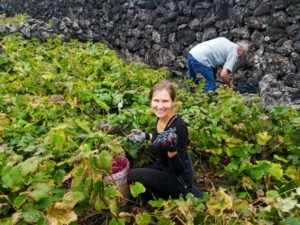
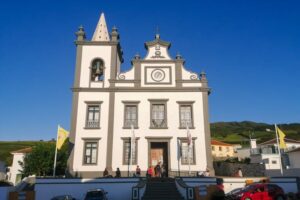
Serreta, or where the inhabitants of Terceira go every September „This weekend we’re going to Serreta, do you want to go with us?” – my friend asked me a few days ago. I wanted to. I put on comfortable shoes, sunglasses, packed my backpack with food, water, sweatshirt and raincoat – and off you go. Serreta is a Terceiran Częstochowa (Quick explanation: Częstochowa is a Polish cult place where pilgrims go from all around the country every year). Every year, pilgrimages to Serreta take place. The inhabitants of Terceira wander to the sanctuary in Serreta from every part of the island. Some people even go around the island, making about 80 km on foot. Some people go to ask for something. Others to show gratitude for the past year. Others to meet friends, drink beer and eat bifana. (Bifana is the often mentioned bun with a cutlet, available in almost every tasca, i.e. a foodtruck). And to see the tourada à corda and pull for capinhas. This year, for obvious reasons, no great festival was organized. Usually there are tascas, music and fireworks. This year – only pilgrims wandering the streets of Terceira throughout the week. And a man with hand sanitizer at the entrance to the church. Nossa Senhora dos Milagres – Our Lady of Miracles In the Azores and in Portugal, Nossa Senhora dos Milagres, or Our Lady of Miracles, is highly revered. There is a sanctuary named after her in Serreta. There is a painting under the same invocation. It is said that this painting saved a priest who was running away from danger in the 17th century. As a thank you for that care, the priest built a chapel in which he placed the painting. It was in the area of today’s Serreta. After the priest’s death, the painting was transferred to a church in the nearby village of Doze Ribeiras. This image served the Terceiran people, as did the image of Our Lady of Częstochowa (PL: Matka Boska Częstochowska) for Poles. In the 17th century, Portugal was involved in the war between France and Spain, and Great Britain. Terceira, a small island, was virtually defenseless in this war. Residents turned to Our Lady of Miracles with a request for protection. They promised that if the island did not suffer any attack from the enemy, they would organize an annual festival in honor of Our Lady of Miracles. What they did. Festivals in honor of Our Lady of Miracles The first festival of the Festas da Nossa Senhora dos Milagres was held on September 11, 1764. In 1842, the church in Serreta was built, the miraculous painting was brought back to it – and since then, the festivals are held regularly. And since 2006, when the church was elevated to the rank of a sanctuary, the holidays have been even more sublime. These are religious and secular holidays that blend in with the image of the island. On the day of my planned pilgrimage, a friend asked me why I was not staying on the beach any longer. After all, the weather is beautiful and you could „get cooked” at home. I replied, „Because I’m going to Serreta.” And it was all clear. Serreta is local code, everyone knows what’s going on. Serreta connecting people Serreta Weekend is one of the biggest events during the summer of Terceira. It connects old and young, believers and non-believers, fun-oriented and calm ones. The phenomenon of Terceira is that you can really feel the equality of all people here. Festivals in Serreta are one of the occasions to experience this unity. There are no better or worse, they are all equally important and the equally warmly welcomed. Isn’t it the social bond that we want? The Azores Read more about Azores 2018-01-25 The Azores 10 places worth visiting in Terceira 10 places worth visiting in Terceira When I decided to describe 10 places worth visiting in Terceira, I thought: but there are many more places worth visiting here! Terceira is a small island (around 400 sq. m) but full of beauty. But I realize that not everybody has a privilege… 2018-06-04 The Azores Festas do Espírito Santo Festas do Espírito Santo – what’s that? Festas do Espírito Santo – the Holy Spirit’s festivities – are one of the most distinguishable Azorean traditions. Their history starts in the 17th century, when Holy Spirit’s cult appeared in mainland Portugal. Sources don’t tell about any specific date, they just suggest… 2018-08-25 The Azores Tourada à corda – bulls in Terceira Tourada à corda, or a story about bulls running on the streets I was with a Polish friend who was on Terceira on Erasmus, on a tourada. He spotted someone in a Legia shirt in the crowd (Legia is a Polish football team). He told me: „Milena, look, there’s a…
Capinha, tourada and bulls, i.e. Terceira tradition behind the scenes

I wrote recently that I took part in an event in which I didn’t expect to participate. Someone guessed it had something to do with bulls. That something – it was Festival de capinhas. Capinhas festival. It started with my friend João saying: „We have a capinhas festival on Friday, do you want to come?” To my surprise – I wanted to. I watched bulls running freely in the arena and capinhas, i.e. people who – as is used to say here – play with bulls. Including my friend João. I understood what so many Terceira people might see in such events. Adrenaline and emotions There is admiration for the bulls and for the capinhas. Adrenaline and emotions that go up even more when the bull jumps over the railings. Or when you see someone you know in the middle of the arena. Looking straight into the eyes of the bull running at him. I’ve already been to several Terceira traditional touradas à corda. (These are events where bulls run in the streets; I wrote about it in more detail in the article „Tourada à corda„). But it was my first time at the Capinhas festival. I even had to ask who the capinhas were, I didn’t know the word. I learned that capinhas are people who appear during the tourada on the way of the bull’s run and attract its attention. They annoy it, call out to another place. They use rags, umbrellas or hands for this. Yes, hands. Some people put them on the head of a bull and go around in circles with the bull. My friend João is known to fans of touradas as capinha After the festival, I thought you might be interested in what the „world of bulls” looks like behind the scenes. After all, many people come to Terceira because of the tourada! So I interviewed João and learned a lot of interesting things. How it all started We’re sitting down and starting talking. First, I’m asking João about his history with tourada and bulls. „I’m from Terceira, bulls are in my blood,” he’s replying. And he’s starting talking about the fact that as a child he used to go on touradas to watch his grandfather. His grandfather was a capinha, and he wanted that too. He was always curious what it was like to face a bull. Until the first time it finally happenned. „I went once – and it stayed that way.” I’m asking João what’s the role of capinhas during the tourada “Capinha’s task is to animate the tourada. Without capinhas, there’s no tourada. The bull runs back and forth on the street, nothing’s happening. People who like touradas also like capinhas and what we do. The role of capinhas is to entertain the tourada participants. I never thought about it that way. I thought capinhas go on tourada more for themselves than for the audience. And here’s a surprise. Though it’s undeniable that these are adrenaline-loving people come into this role. “We feel adrenaline. A flare shot – and you just feel it. We play with the bull, but it’s dangerous fun. We feel the breath of the bull close to us. It’s a danger, but it’s such a… good danger. „ To become a capinha you just have to want it And show up on a tourada. There’s no need to let anyone know in advance, tourada is an event open to everyone. However, many newcomers are turning to capinhas who are more familiar with the subject for help. The bull can weigh even a ton, it inspires fear and respect. Therefore, beginner daredevils are sometimes accompanied by capinhas with more experience. Tourists sometimes too, but it’s usually tourists who get hurt by the bull. Because they don’t know how to behave. And I would like to remind you (see the article „Tourada à corda„) that the insurance doesn’t cover damage caused by the bull. For your own safety, leave playing with bulls to people with more experience. The basic rule on tourada is safety Safety of people and bulls. Capinhas play with the bull, run around. But when they see that the bull is very dangerous, they don’t risk their lives. „This is not our livelihood,” says João. “We go on a tourada to have fun and entertain the audience, but we all want to go home. Professionals, for example, in Spain, are different. All their lives are bulls. We go to our work, leave it in the evening and go on a tourada. And we want to come back from tourada safe and sound. I’ve had four serious accidents, got hit on my head once, and passed out. The fewer accidents the better.” I’m asking about the bulls. And learning that capinhas and tourada organizers also keep the bulls safe. Some time ago, a bull would hit a wall with a horn, break the horn, and run on. Not now. Now in such a situation the bull is immediately taken from the street and cured. João also tells me that when capinhas see that someone in the public is putting the bull in danger, they react immediately and drag the bull away. “We want safety for the bull as well, not only for ourselves. The bull also has its rights.” I’m beginning to wonder how capinhas get prepared for touradas I’m hearing in an answer that their only preparation are possible „touradas” with cows – mothers of bulls. Grenadiers, or cattle breeders, want to know which cow will make a good mother for the next good bull. Good, meaning big and brave, which can be proudly exhibited on tourada. So they invite capinhas to such „cow touradas”. The capinhas train and the grenadiers learn which cow is worth investing in. The best bulls are selected for touradas Sometimes these are famous bulls. The ones who have already participated in many touradas and know how to react to capinhas and other people on the streets. At
Marralhinha – the most popular game in Terceira

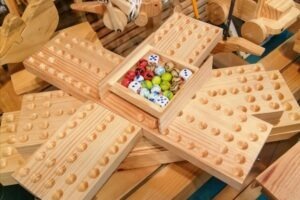
When I met my friends for the first time after the lockdown, a marralhinha entered the table. I usually yawn at 23:00 and that night I was sitting at the game until 2am, and my friends finished the tournament at 5am. Yes, you are thinking right – marralhinha draws in. Fortunately, not like Jumanji (although… if you look at 2020…), but it draws you in! Marralhinha is a typical game from Terceira. I got to know it paradoxically in Lisbon, when I was returning from Poland after Christmas. (It was also the first time I felt how terribly cold it is in the houses in Lisbon in winter). My friends had a visit of their friends, marralhinha appeared on the table. A wooden „board” with pits, marbles – and the evening was endless. This is a game that evokes emotions A fighting spirit awakens in calm people. Everyone wants to win, everyone creates a strategy in their head. And changes it after each dice roll. Because it’s a game in which strategy is mixed with statistics. Whoever has lost, willingly stands up for a rematch. Whoever won, starts the next games even more willingly. And so until morning. Marralhinha is a traditional game of Terceira There are two versions of the story of this game’s popularity in Terceira. One says that it was brought from the United States by a Terceira emigrant – in a version slightly different from the present one. The second version says that a similar game was very popular in one of the regions of France and from there it made its way to Terceira. How it really was – maybe one day we’ll find out. Maybe not. The lack of certainty as to the origin of the game does not prevent the inhabitants of the island from passionately playing it. There was even an Association of Party Games in Terceira established! The association regularly (of course, apart from the Jumanji year, i.e. 2020) organizes tournaments in which up to twenty teams play marralhinha (it is played in pairs). It’s really a lot of people for Terceira. You can buy Marralhinha in almost any souvenir shop. Or directly at handicraftsmen, for example at various handicraft fairs (they are organized, for example, on the occasion of Sanjoaninas LINK and Festas da Praia). If you only have carry-on luggage, make sure you select a game size that will fit in your luggage. My friends ended the first party after quarantine with a clear division into winners and all the rest, which pretended not to care about the loss. I’m kidding. Partly. Because there were clear winners. But the rest had a good time too. Me too. Until sleep got me down, but that’s another story. In the meantime – the principles of marralhinha! If you accidentally bought it and didn’t know how to play it. Or if you got a marralhinha as a gift. Like my family from me. With instructions in Portuguese. One and a half year ago… Marralhinha – rules of the game (Original rules in Portuguese HERE. Below – translation based on the rules version available on 30th of July, 2020) Two 2-person teams take part in the game. Each player has 5 marbles (10 marbles per team). Each player rolls a dice. The player with the highest score starts the game. The second player to his right is second (turn is going counterclockwise). In order for the marble to leave the starting fields, the player must roll 1 or 6 on the dice. The first player of any team, once (s)he has placed his/her five marbles in the end fields, continues play by helping his/her partner finish the game. When a 6 is rolled, the player must move the marble and roll the dice again. If, after rolling a 6, he/she places the last marble in the end fields, he/she rolls again to help his/her partner end the game. The player moves forward the number of spaces equal to the number on the dice. (Example: if you roll 5, you move the marble of your choice 5 spaces forward.) To enter or leave the center of the board, you must roll 1 or 6 dice. The square in the middle of the board is to help players shorten their path to the end fields. The center of the board can be entered from any of the three corners next to the center of the board (furthest from the end fields). When leaving the center of the board, the player must move to the corner closest to his end fields. (Here is my comment: according to the rules I learned, theoretically, you can move to other corners – but it doesn’t normally pay off, because the goal of the game is to reach the end fields as quickly as possible for both players). None of the five marbles of a player may overtake other marbles of the same player on the board. After playing a dice and picking up one of his marbles, the player is obliged to play this marble, unless he/she would make it to the square occupied by his/her partner’s marbles. If a player rolls 1 or 6 on the dice and picks up one of the marbles in the starting squares, and the starting field is not occupied by his or her partner’s marble, the player is obliged to put the marble into play (put it in the starting fields). In order to move the marble, a player must count the pits on the board, risking that his/her move will be canceled in the event of a mismatch. If during the movement of the marbles, the player gets to the field occupied by the opponent, he/she must gently touch the opponent’s marbles, remove it from the board and place it in the opponent’s starting field. The next player in line must wait with rolling the dice until the previous player has finished his/her move. If they the dice before their
Angra do Heroísmo – the capital of Terceira on the UNESCO World Heritage List

Angra do Heroísmo is the capital of Terceira. Calm, charming, full of treasures to discover. Its historical center is inscribed on the UNESCO World Heritage List. If you were on Terceira, you were certainly walking around enchanted by the streets of Angra do Heroísmo. If you haven’t been – everything ahead of you! But before you get here, you can enjoy pictures of Angra. You can find them, for example, on Facebook and Instagram. In Angra you can feel as if we traveled back in time. Terceira was discovered and inhabited in the second half of the 15th century, and some buildings in Angra remember the early 16th century! So the first explorers or their children could walk on their corridors! Angra do Heroísmo on the UNESCO World Heritage List Angra do Heroísmo was inscribed on the UNESCO World Heritage List in 1983. The basis was two cultural criteria: • IV – the place has to be an outstanding example of a type of building, architectural or technological ensemble or landscape which illustrates (a) significant stage(s) in human history; • VI – the place has to be directly or tangibly associated with events or living traditions, with ideas, or with beliefs, with artistic and literary works of outstanding universal significance. (this criterion should preferably be used in conjunction with other criteria); When we look around Angra, we will see that history is present at every step here. Angra do Heroísmo is the first settlement in the Azores that received city rights. FIt’s been considered a city since 1534. In the same year, it became the seat of the diocese, which also affected its development. From the 16th to the 19th century it was the most important port of call in the Atlantic. Mostly for fleets sailing to and from India, but other ships crossing the Atlantic also stopped here. The ships were full of treasures from India and the Western world: gold, silver, oriental spices. They became the target of pirate attacks. Angry Bay, sheltered by the Monte Brasil peninsula, was a great haven. Two fortresses protected the island from external attacks: the São João Baptista fortress located by Monte Brazil and the fort São Sebastião (known as Castelinho) in Porto de Pipas („port of barrels”). Angra was developing, which was reflected in its architecture. The Sé cathedral, the Customs Office building, the church of Misericórdia (Mercy), the Franciscan convent – these are just some of the many monuments that confirm the importance of the capital of Terceira at that time. Angra do Heroísmo was also wisely built Angra is not only full of unusual monuments, but also very wisely built. When the first explorers reached Terceira, they saw the island with a large peninsula adjacent to its southern coast. The peninsula formed two bays and provided natural protection against wind and strong ocean waves. It is no wonder that they decided to settle there. The city grid is slightly skewed, comparing to the traditional buildings of those times. The first settlers built it, taking into account local winds, which indicates their great adaptation to the existing geographical conditions. Angra do Heroísmo has already survived the earthquake, may it survive also the following years On January 1, 1980, Terceira was hit by an earthquake of strength 7.2 on the Richter scale. Half of Angra was literally in ruins. However, most of the buildings were reconstructed according to their original plans. That is why today we can admire the unchanged shape of the historical center of the capital of Terceira. For those who have a house in the historical part of Angry, renovation work can be a trouble. You need to get a pile of permits, you need to keep the original facade, you need to remember about specific construction techniques. But when I walk the streets of Angry, I am grateful to the residents for their effort. It’s just beautiful here. Let it stay that way!
Tourada à corda – bulls in Terceira

Tourada à corda, or a story about bulls running on the streets I was with a Polish friend who was on Terceira on Erasmus, on a tourada. He spotted someone in a Legia shirt in the crowd (Legia is a Polish football team). He told me: „Milena, look, there’s a guy in Legia’s shirt!” I wasn’t too conscious so I asked him what Legia’s shirt looks like. He explained, I spotted the man he was talking about and after a moment of hesitation we said: „Let’s go!” Nearby, there was a tasca (it’s kind of a foodtruck, seen here mainly at touradas and other special events), in which our countrymate was ordering something to drink. We told him „Good afternoon” and started a conversation. „What brought you to Terceira?” „I came to Terceira especially to see the bulls!” – answered our interlocutor. He amazed us enormously. We listened to his story: „I learned last year that there were bull runs in the Azores, and I wanted to see them. So I bought a ticket to the Azores and flew, but I got to São Miguel. And it wasn’t until I got there when I learned that I should have gone to Terceira. This year I came here.” I was very surprised that someone flew through half of Europe and half of the Atlantic Ocean in order to see how bulls run in the streets, but as I thought later about the reactions of various friends of mine to this phenomenon – I stopped being surprised. Touradas à corda are definitely one of Terceira’s distinguishing features. Bulls on the street are normal here At least from May 1 to October 15. During this period, touradas take place almost every day in one or more places. This means that the bulls, which are normally crowded in fields and pastures (right next to the cows, which are more numerous than people in the Azores), go out „into the street”. And they are more or less willing to meet the crowd of people gathered especially for them. Tourada à corda is an event that unites the community It’s a reason to meet, talk, spend time together. Lost wanderers will find a place on someone’s wall or even a yard. At this time, there are no differences between people – everyone wants to be safe and have the best perspective. To meet friends, laugh, hold your breath. Stay with each other in this exciting moment. What is the tourada à corda? Okay, so what’s the point? Well, the tourada à corda means bulls running along the street, held on a rope by two groups of 3-5 men each, called pastores (shepherds). The bull is usually mature and experienced in battle (although there are also younger and unfamiliar with the subject), and pastores – tough and hungry for adrenaline. And dressed in white shirts, gray or black pants and black hats. Daredevils annoy bull often equipped with umbrellas or sheets, and the entire spectacle is watched by the people gathered in the surrounding courtyards and fences. How to behave on tourada Before I mention the tradition of quinto touro, which is associated with the great hospitality of the inhabitants of Terceira and the unification of the community, maybe a few words about how to behave on tourada and what technical issues related to it look like. First of all – take care of your safety If your health and life are valuable to you, then you better watch out. Check in advance exactly where and when the tourada is taking place and appear there at least half an hour earlier. Tourada can be an exciting but also dangerous event. From the technical point of view – insurance doesn’t cover close meetings with a bull. If something happens to you, it is only your fault, so it’s better to take care of yourself in advance and find a place where you will definitely be safe. Second of all – leave the car away Leave the car far away (usually there will be no more places nearby anyway, all surrounding roads will be blocked) and come to the tourada by foot. Why? Well, so that by any chance your car doesn’t become interesting for a bull. No insurance will cover this for you. Tourada should not start if there are vehicles on its route, but it’s better not to risk it. Third of all – find a suitable place The bull usually runs along a street about 500 m long. If you want a good view, you have to find a place either along this street, on a safe (high!) wall or behind a fence. Most fences are protected with boards at this time – this applies to both private properties and tascas, i.e. the foodtrucks mentioned above, which are extremely popular during touradas. (Digression – you will buy in tascas beer, local liqueurs and aguardente, i.e. local moonshine, as well as bifanas, i.e. buns with a cutlet – the most popular local fast-food. And you will find peanuts, olives and lupine grains to be eaten. The owners of the tascas often offer their guests beer and don’t like „no” as an answer). If you don’t know where to hide – ask someone. Even if (s)he doesn’t speak English, (s)he’ll show you a safe place anyway. And if the bull is already on the street, and you haven’t found your place yet – stay where you are (as long as it’s not at the bull’s route). At the end of the bull’s „route” there’s a policeman and three white lines. Stay behind the third, which means a safety zone. Of course, unless the bull breaks from the rope etc. etc., but that’s another story. Fourth of all – listen to the sound signs Four bulls take part in the tourada, but they are not released at the same time. All bulls wait in their cages for their turn and are released one by one. Letting the bull